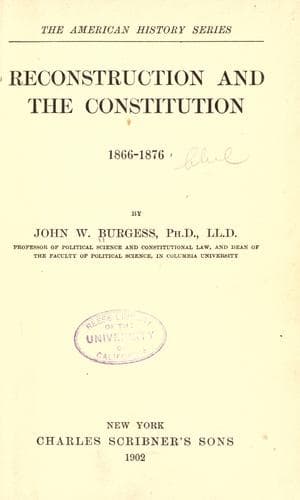
Reconstruction and the Constitution, 1866-1876Burgess, John William
History
Reconstruction and the Constitution, 1866-1876
Burgess, John William
Reconstruction (U.S. history, 1865-1877); United States -- Politics and government -- 1865-1877
It is certainly true that full freedom implies civil liberty and civil
equality, but there was another way, and a better way, to have secured
these than by the immediate and universal suffrage of the newly
emancipated in all their ignorance, immorality and poverty, and that
was by the nationalization of civil liberty, and its protection and
enforcement by the United States courts. Most of the {218} Republicans
believed, at that moment, that that had been secured by the Fourteenth
Amendment; and there can be little question that a very important
consideration with such was the fear that after Reconstruction should
be accomplished, the Southern "States" might amend negro suffrage out
of their "State" constitutions, and thus destroy the Republican party
in these "States," unless the Constitution of the United States should
be so amended as to prevent it. The most radical among them were no
doubt moved chiefly by the extravagant humanitarianism of the period,
which had developed in their minds to the point of justifying not only
the political equality of the races, but the political superiority, at
least in loyalty to the Union, the Constitution and republican
government, of the uncivilized negroes over the whites of the South;
but that this conviction was not very strong among the masses of them
can be readily concluded from the fact that that party is to-day the
party which is following the European idea of the duty of civilized
races to impose their political sovereignty upon uncivilized, or half
civilized, or not fully civilized, races anywhere and everywhere in the
world. No party can, in so short a time, so completely change its
fundamental principle of political ethics when it is really and
conscientiously believed in by the masses of the party.
[Sidenote: Johnson's retirement from the presidency.]
This proposed Fifteenth Amendment was not sent to the President for his
approval, but went, according to custom, to the Secretary of State, to
be submitted to the "State" legislatures. The President was now within
a very few days of the end of his term. His sun had fairly set, and the
disrespect felt for him by the members of the dominant party in
Congress and out of Congress was expressed in the rude and quite
unprecedented refusal of General Grant to sit in the same carriage with
him in the {219} procession from the White House to the Capitol, on the
4th of March, for the ceremonies of the inauguration of the new
President. Discredited, despised, and scoffed at, as a traitor to his
party, to his political creed, and to his country, Mr. Johnson stepped
down from the high office which he had occupied during one of the two
most critical periods in American history since the establishment of
the present Constitution.
[Sidenote: The President and the Republican party.]
Public-domain text, read in full here on John Shaqi.
Reviews
Reviews
No reviews yet
Be the first to share your thoughts on this work.
Elsewhere in the archive
Join the Discussion
Join the discussion
Sign in to leave a comment or review.
Sign InorCreate an account