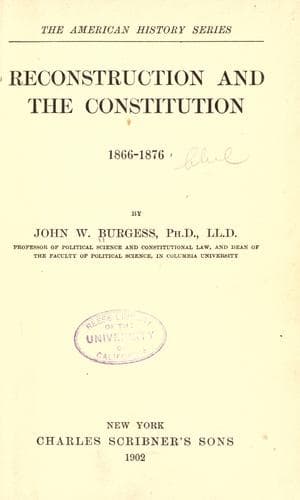
Reconstruction and the Constitution, 1866-1876Burgess, John William
History
Reconstruction and the Constitution, 1866-1876
Burgess, John William
Reconstruction (U.S. history, 1865-1877); United States -- Politics and government -- 1865-1877
And yet it is certainly true that the Republican party had left him
rather than that he had left the party. This party began simply as a
Union party and an anti-slavery extension party. Mr. Johnson, an
original Democrat, joined with the Republicans upon this basis, and he
never left it. On the other hand, when the necessities of the war for
the Union made it evident that the slaves within the Southern
communities which had declared secession, and were engaged in
rebellion, must be proclaimed free, Mr. Johnson still went with the
Republicans in the justification of this measure. And when, finally,
the war was ended and the Union was preserved, and the Republicans
decided that the legitimate outcome of the victory was the prohibition
of slavery everywhere within the United States by an amendment to the
Constitution, Mr. Johnson still marched with them, at the head of the
column. It was only when they became more and more radical in their
policy, and insisted upon transforming rather than restoring the
"States" of the South, by placing civil rights under national
protection instead of "State" protection, disfranchising the whites of
the South, and enfranchising the negroes, and upon overcoming the
Executive's objections to these movements not simply by overriding the
veto, but by generally subordinating the Executive to Congress--it was
only then that he {220} separated from them and fell back naturally on
such support as he could get, which was chiefly from the Democratic
party.
Public-domain text, read in full here on John Shaqi.
Reviews
Reviews
No reviews yet
Be the first to share your thoughts on this work.
Elsewhere in the archive
Join the Discussion
Join the discussion
Sign in to leave a comment or review.
Sign InorCreate an account