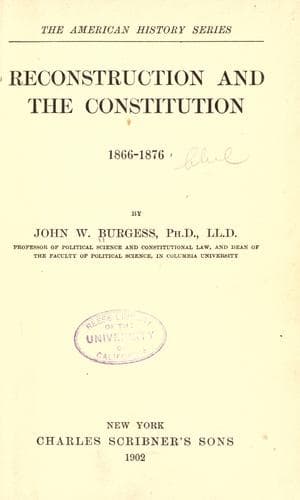
Reconstruction and the Constitution, 1866-1876Burgess, John William
History
Reconstruction and the Constitution, 1866-1876
Burgess, John William
Reconstruction (U.S. history, 1865-1877); United States -- Politics and government -- 1865-1877
In his inaugural Address the new President made no reference to these
questions, but he had hardly been one month in the presidential office
before he recognized the difficulties with which his predecessor had
been beset, and asked and almost demanded of Congress relief from them.
On the 7th day of April he addressed a message to Congress requesting
that body to provide for submitting to the voters of Virginia the
"State" constitution drafted and adopted by a constitutional convention
at Richmond nearly a year before, and recommending that "a separate
vote be taken upon such parts as might be thought expedient," and that
the constitution, "_or such parts thereof as shall have been adopted by
the people,_" should be submitted to Congress on the first Monday of
the following December, and that the officers provided for under the
said constitution should be chosen at the same election.
The President also suggested that the constitution framed by the
convention in Mississippi and rejected by the voters might be
resubmitted in the same way. The events in Mississippi culminating in
the rejection {224} of the proposed State constitution by the voters in
June of 1868 have been already related.
[Sidenote: The Virginia case.]
The case of Virginia, on the other hand, which differed in several
material respects from that of any of the others, has not been as yet
sufficiently stated for a clear understanding of the President's
meaning in his recommendations to Congress of April 7th. It will be
remembered that a loyal government of Virginia, with its seat first at
Wheeling and then at Alexandria, existed during the entire period of
the Civil War, and that from 1861 to 1864 Virginia, under this
government, had been represented in Congress, and that it was this
government which consented to the partition of Virginia recognized by
Congress. On the 23d day of May, 1865, this government transferred
itself from Alexandria to Richmond, having been recognized by President
Johnson on May 9th as the true government of Virginia. The legislative
department of it met in session on the 20th of June following. The
Governor, Mr. Pierpont, recommended, in his message to that body, that
a constitutional amendment should be drafted, and proposed by it to the
voters for ratification, which would enfranchise, and qualify for
office, a much larger proportion of the people than was the case under
the revised constitution of Virginia of 1864, adopted by the loyal
convention at Alexandria. The legislature followed the Governor's
advice and proposed an amendment to the voters which granted suffrage
and eligibility substantially to the old ante-bellum electorate and
eligibles on the condition of future loyalty to the United States. This
proposition was voted on at the elections held on the 12th of October
for the choice of members of the legislature and of the lower House of
Congress, and was ratified by a large majority. The election was held
Public-domain text, read in full here on John Shaqi.
Reviews
Reviews
No reviews yet
Be the first to share your thoughts on this work.
Elsewhere in the archive
Join the Discussion
Join the discussion
Sign in to leave a comment or review.
Sign InorCreate an account