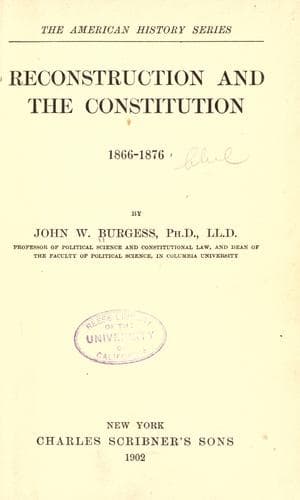
Reconstruction and the Constitution, 1866-1876Burgess, John William
History
Reconstruction and the Constitution, 1866-1876
Burgess, John William
Reconstruction (U.S. history, 1865-1877); United States -- Politics and government -- 1865-1877
in every county and the result was fairly {225} representative of the
people. There was lacking but one thing more for the complete
restoration of the "State" to its federal relations, viz., the
admission of the Senators and Representatives from it to seats in
Congress. They presented themselves at the opening of the Congressional
session on the first Monday of December following, and were excluded,
along with the Senators and Representatives from the other "Johnson
States," by the Stevens resolution.
[Sidenote: The Vagrant Act.]
[Sidenote: General Terry's order setting aside the Vagrant Act.]
For more than a year, however, this government continued to act as the
"State" government of Virginia, under the limitations placed upon it by
the presence of the military of the United States, and the interference
of the commanding general in behalf of the freedmen. On January 15th,
1866, the legislature chosen at the October elections of the preceding
year passed the vagrant act, which defined as vagrants "all persons
who, not having wherewith to maintain themselves and their families,
live idly and without employment, and refuse to work for the usual and
common wages given to the laborers in the like work in the place where
they are," and which authorized the condemned vagrant to be hired out,
and his wages applied to his own use or the use of his family, and, in
case of his running away from the hirer, to be apprehended on the
warrant of a justice and returned to the hirer, who should have one
month of service extra, and without wages, for the interruption of the
service contracted for, and other trouble and expense, and should also
have the right, by permission of the justice, to work the returned
vagrant with ball and chain, in order to prevent a repetition of his
flight. On the 24th, just nine days after the passage of the act,
General Terry, the military commander at Richmond, issued an order
setting aside this measure as to the freedmen. He based his order on
the {226} tendency of the statute to influence employers to combine for
the purpose of lowering the wages of the freedmen to a point that would
pauperize them and drive them into vagrancy, and create thus the very
situation which, under the operation of the measure, would lead to a
species of servitude worse than the old domestic slavery. He had no
reliable facts of experience upon which to base his theory. It was a
bit of political and economic prophecy on his part. It was sufficient,
however, to call down maledictions from the Congress at Washington and
the people of the North upon the legislature at Richmond and the people
of Virginia and of the South generally.
[Sidenote: Virginia made a Military District.]
Public-domain text, read in full here on John Shaqi.
Reviews
Reviews
No reviews yet
Be the first to share your thoughts on this work.
Elsewhere in the archive
Join the Discussion
Join the discussion
Sign in to leave a comment or review.
Sign InorCreate an account