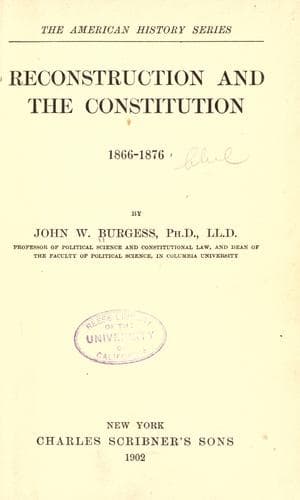
Reconstruction and the Constitution, 1866-1876Burgess, John William
History
Reconstruction and the Constitution, 1866-1876
Burgess, John William
Reconstruction (U.S. history, 1865-1877); United States -- Politics and government -- 1865-1877
Congress, however, gave this legislature one more opportunity to redeem
itself. The proposed Fourteenth Amendment to the Constitution of the
United States was submitted to it for ratification in June of 1866.
After long deliberation upon it, the legislature rejected it on the 9th
of January, 1867. This act sealed the fate of that legislature.
Virginia was brought, with the other Southern communities which had
rejected or not adopted the proposed Amendment, under the
Reconstruction Acts of March, 1867, and became the first military
district under those Acts, with General Schofield as commander.
Schofield ordered the election for delegates to a constitutional
convention, by the voters designated in the Reconstruction Acts, to be
held in November of 1867, and ordered the delegates so elected to
assemble in Richmond on the 3d of the following December. These orders
were successfully executed under the supervision and control of the
military. Schofield himself appeared in the convention, and urged the
delegates to be moderate in the propositions for the disfranchisement
and disqualification of those who had participated in rebellion. But
the delegates {227} elected under the Reconstruction Acts, and by the
electorate created through them, were not only radical, but bent upon
retaliation. They would not listen to the wise counsel of Schofield,
but drafted and adopted such provisions in regard to suffrage
qualifications and eligibility to office and mandate as would have put
the "State" government, based on such a constitution, in the hands of
negroes, "scalawags" and "carpet-bag" adventurers. The opposition to
these provisions on the part of the commander and the Administration at
Washington was, however, sufficiently effective to delay indefinitely
the submission of the constitution to the voters. Near the end of the
year 1868, a conference of prominent Virginians assembled at Richmond
and appointed a committee, and sent its members to Washington to
petition Congress to allow the disfranchising and disqualifying
clauses, and the clauses in reference to county organization, to be
voted on separately from the other parts of the proposed constitution.
This committee proceeded to Washington in January of 1869, and argued
their case before committees of both of the Houses of Congress, and
also presented the same to the new President-elect, General Grant.
[Sidenote: Grant's message to Congress of April 7th, 1869, and his
proclamation of May 14th.]
Public-domain text, read in full here on John Shaqi.
Reviews
Reviews
No reviews yet
Be the first to share your thoughts on this work.
Elsewhere in the archive
Join the Discussion
Join the discussion
Sign in to leave a comment or review.
Sign InorCreate an account