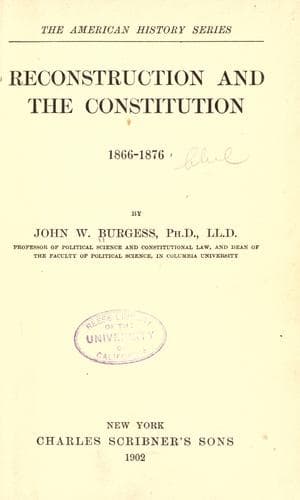
Reconstruction and the Constitution, 1866-1876Burgess, John William
History
Reconstruction and the Constitution, 1866-1876
Burgess, John William
Reconstruction (U.S. history, 1865-1877); United States -- Politics and government -- 1865-1877
In this form and with this content the bill was returned to the House.
Here it was again debated, off and on, until June 24th, when it was
finally agreed upon with the following contents: "That the State of
Georgia having complied with the Reconstruction Acts, and the
Fourteenth and Fifteenth Articles of Amendment to the Constitution of
the United States having been ratified in good faith by a legal
legislature of said State, it is hereby declared that the State of
Georgia is entitled to representation in the Congress of the United
States. But nothing in this act contained shall be construed to deprive
the people of Georgia of the right to an election for members of the
general assembly of said State, as provided for in the constitution
thereof," and "That so much of the Act of March 2d, 1867, as prohibits
the organization, arming, or calling into service of the militia forces
in the States of Georgia, Mississippi, Texas and Virginia be, and the
same is, hereby repealed."
The Senate disagreed to the bill in this form and with these contents,
and asked for a conference committee. The House agreed and appointed
members. The conference committee agreed upon the bill as {244}
perfected by the House with the addition to the second section of these
words: "And nothing in this or any other Act of Congress shall be
construed to affect the term to which any officer has been appointed or
any member of the general assembly elected, as prescribed by the
constitution of the State of Georgia." Both the Senate and the House
accepted and concurred in the recommendations of the committee, and the
bill, as thus perfected, became law on the 15th day of July, 1870. This
bill terminated the era of Reconstruction legislation by Congress, and
at the next session of Congress, the session of 1870-71, the Senators
and Representatives from Georgia were admitted to their seats, the
Senate admitting those chosen to that body in July of 1868, Messrs.
Hill and Miller. The attempt of Governor Bullock to prolong the terms
of the members of the legislature and of the officers of the "State"
government was decidedly disapproved of by President Grant's
Administration, and an election was held for members and county
officers and for Representatives in Congress in December of 1870. The
white residents of the "State" stood well together, and carried the
election by a large majority against the Republicans. So soon as the
result was known Governor Bullock, whose term had still two more years
to run, abandoned his office and left the "State," and Georgia was thus
early rescued from negro domination, or rather "carpet-bag" domination
through negro suffrage. Her harder experiences during the years from
1868 to 1870 had worked out to her advantage, in that it brought the
respectable and capable portion of her white citizens together earlier
than was the case in the other reconstructed Commonwealths similarly
situated.
Public-domain text, read in full here on John Shaqi.
Reviews
Reviews
No reviews yet
Be the first to share your thoughts on this work.
Elsewhere in the archive
Join the Discussion
Join the discussion
Sign in to leave a comment or review.
Sign InorCreate an account