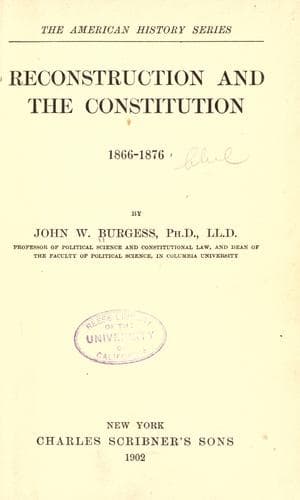
Reconstruction and the Constitution, 1866-1876Burgess, John William
History
Reconstruction and the Constitution, 1866-1876
Burgess, John William
Reconstruction (U.S. history, 1865-1877); United States -- Politics and government -- 1865-1877
[Sidenote: Negro rule in the South from the point of view of political
science and ethnical principle.]
From the point of view of a sound political science the imposition of
universal negro suffrage upon the {245} Southern communities, in some
of which the negroes were in large majority, was one of the
"blunder-crimes" of the century. There is something natural in the
subordination of an inferior race to a superior race, even to the point
of the enslavement of the inferior race, but there is nothing natural
in the opposite. It is entirely unnatural, ruinous, and utterly
demoralizing and barbarizing to both races. It is difficult to believe
that the creation of such a relation between the blacks and whites of
the South was at all within the intentions of the framers of the
Reconstruction Acts. They were irritated because these communities
would not accord civil equality to the freedmen, would not accept the
proposed Fourteenth Amendment, and had passed acts which created a new
species of slavery or quasi-slavery of the blacks. They thought they
were placed between the alternative of continuing military government
in the South indefinitely, or giving the negro the political power with
which to maintain his civil rights.
Opposition to military government in time of peace was an ingrained
principle of the American people, and there was a large part of people
of the North, nearly all adhering to the Republican party, who believed
that manhood suffrage was the true principle of a sound political
science. And it was thought that the only way of creating "States" in
the South which would sustain the Republican party was by giving the
negro the suffrage. It is not surprising, then, that they adopted the
course which they did. There was a third alternative, as has already
been pointed out, viz., the placing of these communities under
Territorial civil government and keeping them there until the spirit of
loyalty to the Nation was established and the principle and practice of
civil equality among all citizens was made thoroughly secure. {246}
But, as has been said, the idea that these communities were "States" of
the Union, notwithstanding their rebellion against the United States
and their attempted secession from the Union, seemed to prohibit the
following of this course, the only true and sound course. And so these
unhappy communities were given over, as sham "States" of the Union, to
the rule of the ignorant and vicious part of their population, to be
sustained therein by the military power of the Nation, under the excuse
that that part alone was loyal.
Public-domain text, read in full here on John Shaqi.
Reviews
Reviews
No reviews yet
Be the first to share your thoughts on this work.
Elsewhere in the archive
Join the Discussion
Join the discussion
Sign in to leave a comment or review.
Sign InorCreate an account