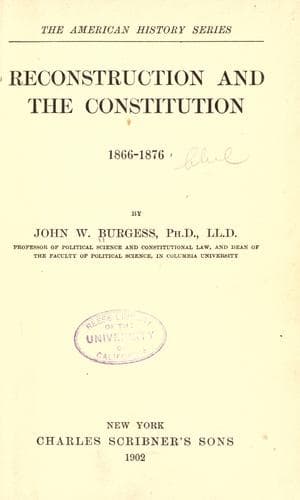
Reconstruction and the Constitution, 1866-1876Burgess, John William
History
Reconstruction and the Constitution, 1866-1876
Burgess, John William
Reconstruction (U.S. history, 1865-1877); United States -- Politics and government -- 1865-1877
Before all of the Southern communities had been admitted to
representation in Congress, and before any of them except Tennessee had
gotten fairly under way with their new "State" governments, a bill was
presented in Congress to provide for the enforcement of the Fourteenth
and Fifteenth Amendments to the Constitution of the United States. It
will be remembered that these Amendments authorized the exercise of
power by the United States Government against "State" action only. They
read: "No _State_ shall make or enforce any law which shall abridge the
privileges or immunities of a citizen of {254} the United States; nor
shall any _State_ deprive any person of life, liberty, or property,
without due process of law; nor deny to any person within its
jurisdiction the equal protection of the laws"; and "the right of
citizens of the United States to vote shall not be denied or abridged
by the United States or by any _State_ on account of race, color or
previous condition of servitude."
It is entirely clear from this language that, in the enforcement of
these new provisions of the Constitution, the United States Government
must direct its powers against the action of the "States,"
respectively, through their legislators and officials, and against that
only. But in this bill which became law on the 31st of May, 1870,
Congress enacted penalties not only against "State" officers and agents
for the violation of the Fourteenth and Fifteenth Amendments, but
severe penalties against any _person_ within the "States," as well as
the Territories, who should undertake to deprive by unlawful means any
other person of his right to qualify and vote at any election, and
against any _person_ who under color of any law, statute or ordinance,
regulation or custom, should undertake to deprive any other person of
his civil rights and civil equality. Congress also, in this Act, vested
the jurisdiction over such cases in the United States courts and
authorized the President of the United States to enforce their
decisions by the aid of the United States army and navy if necessary.
Now, while it may probably be rightly claimed that the _Thirteenth_
Amendment to the Constitution, which reads: "Neither slavery nor
involuntary servitude, except as a punishment for crime whereof the
party shall have been duly convicted, shall exist in the United States,
or in any place subject to their jurisdiction," empowers Congress to
make laws protecting the civil rights and civil equality of persons
{255} within the "States" against infringement by other _persons_, and
to invest the officers of the United States, both judicial and
executive, with the power to enforce these laws, since in this
Amendment the prohibition of slavery or involuntary servitude is not
directed against "State" action solely, but against any attempt made by
anybody to create an involuntary servitude, it cannot on the other hand
be claimed, with any show of correct interpretation, that the
Public-domain text, read in full here on John Shaqi.
Reviews
Reviews
No reviews yet
Be the first to share your thoughts on this work.
Elsewhere in the archive
Join the Discussion
Join the discussion
Sign in to leave a comment or review.
Sign InorCreate an account