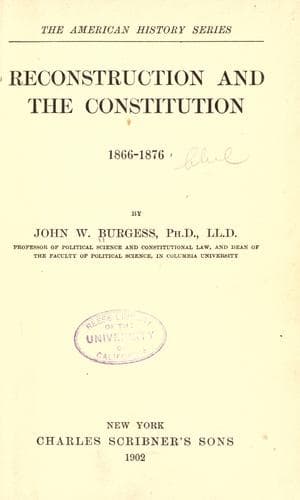
Reconstruction and the Constitution, 1866-1876Burgess, John William
History
Reconstruction and the Constitution, 1866-1876
Burgess, John William
Reconstruction (U.S. history, 1865-1877); United States -- Politics and government -- 1865-1877
_Fourteenth_ Amendment warrants the exercise of any such power by the
United States Government, and it is entirely out of the question to
claim that the Fifteenth Amendment protects the right of a person,
within a State, to vote against the attempt of another person or of
other persons to infringe the same, or even against the "State" itself
to do so, except it be on account of race, color or previous condition
of servitude.
[Sidenote: Criticism of the Act.]
There is not the slightest doubt in the mind of any good constitutional
lawyer, at the present time, that Congress overstepped its
constitutional powers in that part of the Enforcement Act of May 31st,
1870, which related to the exercise of the suffrage, and trenched upon
the reserved powers of the "States." The excuse for it was that lawless
bands of white men, the Ku-Klux Klans and the like, were intimidating
the blacks, and in the approaching elections of the autumn of 1870
would prevent them from voting. But that was a matter for the "State"
governments to look out for, and the "State" governments in the South
were, at the time of the passage of this Act, with the exception of
Tennessee, in the hands of the Republicans.
[Sidenote: The corruption in the new "State" governments.]
Meanwhile the new "State" governments had well begun their career of
corruption, shame and vulgarity. They were plundering the treasury,
increasing the taxes, selling franchises, issuing bonds, and
celebrating {256} high carnival everywhere and all the time. The
gentlemen and political leaders of the old school, and the old
political class, of the South looked on aghast, with mingled feelings
of bitter degradation and anger, and the hotspurs and desperadoes were
stirred to deeds of intimidation and violence. There is little doubt
that some negroes were terrified out of exercising the suffrage in the
election of 1870. Not yet, however, had enough of the disqualified
whites been amnestied, or enough intimidation been exercised, or
sufficient unity among the whites been attained, to work the overthrow
of "carpet-bag," negro rule. Enough, however, was threatened to
influence the Republican Congress to proceed to more complete, if not
more extreme, measures for the protection of the negro in his civil and
political rights, and to move the President to garrison the principal
points in the Southern "States" with United States soldiers.
[Sidenote: The supplemental enforcement Act.]
Public-domain text, read in full here on John Shaqi.
Reviews
Reviews
No reviews yet
Be the first to share your thoughts on this work.
Elsewhere in the archive
Join the Discussion
Join the discussion
Sign in to leave a comment or review.
Sign InorCreate an account