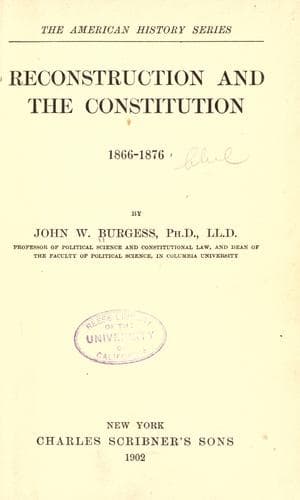
Reconstruction and the Constitution, 1866-1876Burgess, John William
History
Reconstruction and the Constitution, 1866-1876
Burgess, John William
Reconstruction (U.S. history, 1865-1877); United States -- Politics and government -- 1865-1877
As a matter of fact, the Governor of South Carolina had asked the
President to give him United States soldiers for the protection of the
"State" and its citizens against domestic violence, and the President
had, on the 24th of March just preceding the passage of this act,
issued his proclamation commanding the persons {259} composing the
unlawful combinations to disperse and retire to their abodes within
twenty days. This was the method prescribed by the Constitution for
bringing the military power of the United States to the assistance of a
"State" government whenever the "State" government might not be able to
maintain itself against domestic violence. There is no doubt that
General Scott of Ohio, whilom officer in the Union army and in the
Freedmen's Bureau, the "carpet-bag," radical Republican Governor of
South Carolina, attributed the most traitorous character possible to
these combinations, exaggerated the strength and extent of them to the
highest possible degree, and called for United States troops to
suppress them at the earliest possible moment. The most trustworthy men
in South Carolina affirmed then, and have continued to affirm to this
day, that those combinations had no traitorous intent whatsoever, but
were simply defensive in their nature; that the wholesale pardoning of
criminals by the Governor and the vagrancy of the negroes had filled
the country with desperadoes who made life, property, and female honor
insecure; and that, as the militia was composed of the friends of these
fiends, and the "State" government itself would not protect the white
citizens, it was absolutely necessary for the white people to create
some means of united action in self-defence and take the law into their
own hands. Statements to this effect were made by one Judge Carpenter,
a Republican "State" official of South Carolina, before the
investigating committee of Congress in 1871.
[Sidenote: The President's proclamation of May 3d, 1871.]
On the 3d day of May following the passage of the Ku-Klux Act, the
President issued his general proclamation warning the people that the
law applied to the whole country, but particularly exhorting the people
{260} in the newly reconstructed "States" to suppress all unlawful
combinations by their own voluntary efforts, and declaring, that while
he was reluctant to make use of the extraordinary powers conferred on
him by the Act, he would nevertheless do so if it should be found
necessary for securing all the citizens of the United States in "the
peaceful enjoyment of the rights guaranteed to them by the Constitution
and the laws."
[Sidenote: The President's proclamation to the people of South
Carolina.]
Public-domain text, read in full here on John Shaqi.
Reviews
Reviews
No reviews yet
Be the first to share your thoughts on this work.
Elsewhere in the archive
Join the Discussion
Join the discussion
Sign in to leave a comment or review.
Sign InorCreate an account