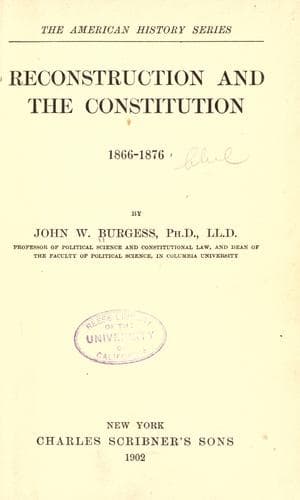
Reconstruction and the Constitution, 1866-1876Burgess, John William
History
Reconstruction and the Constitution, 1866-1876
Burgess, John William
Reconstruction (U.S. history, 1865-1877); United States -- Politics and government -- 1865-1877
Congress answered this appeal with the noted, not to say notorious,
Ku-Klux Act of April 20th, 1871, in which Congress simply threw to the
winds the constitutional distribution of powers between the "States"
and the United States Government in respect to civil liberty, crime and
punishment, and assumed to legislate freely and without limitation for
the preservation of civil and political rights within the "States," and
for the punishment of the infraction of the same by individual persons
conspiring together for that end, and for the punishment of the
conspiracy alone, whether the infraction or the conspiracy was executed
upon, or directed against, officers of the Government or merely private
persons; and {258} in which the act of a combination of private
individuals defying successfully the constituted authorities of the
United States in a given "State," or those of the "State" concerned,
was declared to be rebellion against the United States, upon the
happening, and during the continuance, of which the President might
suspend the privileges of the writ of Habeas Corpus within such
districts as he, by proclamation, might designate.
[Sidenote: The unconstitutionality of the Act.]
The first part of this Act was, unquestionably, an unconstitutional
encroachment upon the powers of the "States," in so far as it is
related to the protection of political rights against infraction, or
against conspiracy for the purpose of infraction, by private persons.
The second part was probably within the powers of Congress, but it was
a most extreme use of its powers. The "State" governments in the South
were in the hands of the Republican "carpet-baggers" and Republican
negroes, and there is no question that the governors and legislatures
of these "States" were quick enough to call in the aid of United States
troops long before it was necessary to do so. Moreover, the militia of
these "States" was composed almost entirely of negroes, and the whites
were forbidden to keep arms. Under such circumstances this Act of
Congress empowering the President to establish martial law upon his own
motion in time of peace within a "State" when combinations of private
persons had successfully defied, in any instance, the laws of the
"State" was a very stiff measure, and unwarranted by the facts of the
situation.
[Sidenote: Interference of the United States military power in the
affairs of South Carolina.]
Public-domain text, read in full here on John Shaqi.
Reviews
Reviews
No reviews yet
Be the first to share your thoughts on this work.
Elsewhere in the archive
Join the Discussion
Join the discussion
Sign in to leave a comment or review.
Sign InorCreate an account