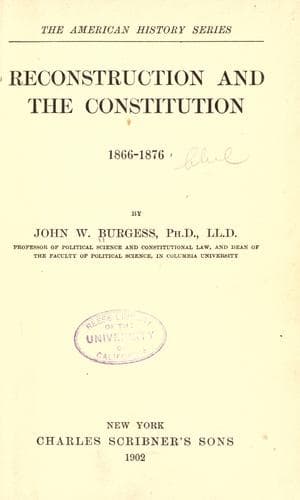
Reconstruction and the Constitution, 1866-1876Burgess, John William
History
Reconstruction and the Constitution, 1866-1876
Burgess, John William
Reconstruction (U.S. history, 1865-1877); United States -- Politics and government -- 1865-1877
During the year 1872, in addition to all this, there came to the
knowledge of Congress and of the people of the North the frightful and
scandalous corruption of the "State" governments in the South. It is
very difficult to get at distinct and reliable facts upon a subject
which officials undertake to cover up and keep shrouded in darkness.
{262} But the record of these doings in South Carolina was something as
follows. The House of Representatives, the majority of the members of
which were negroes, and the presiding officer of which was the
notorious F. J. Moses, spent ninety-five thousand dollars to refurnish
its assembly hall, where the aristocrats of South Carolina had never
spent over five thousand. Clocks costing six hundred dollars each,
sofas two hundred dollars each, chairs at sixty dollars each, desks at
a hundred and twenty-five dollars each, mirrors at six hundred dollars
each, cuspidors at eight dollars each--such were the items of the bill.
In the four years from 1868 to 1872, two hundred thousand dollars were
expended for furniture for the legislative chambers alone. Then came
the bills of supplies, sundries and incidentals, amounting in one
session to three hundred and fifty thousand dollars, one hundred and
twenty-five thousand of it for a free restaurant, lunch counter and
bar, at which the members and their friends fared most royally, eating,
drinking and smoking, and paying not a penny therefor directly, nor
indirectly, since many, if not most, of the members of that legislature
paid no stiver of the taxes. Then came the printing bills, averaging
more than one hundred and fifty thousand dollars a year where ten
thousand dollars would have been more than enough to pay every
legitimate expense of that kind.
Then came the sale of franchises of all kinds, and the pledging of the
credit of the "State" in the form of bonds to aid all sorts of
enterprises pretended to be set on foot, or promoted as is now said, by
combinations of legislators or officials or their friends. In 1868 the
"State" debt was about five millions of dollars, with almost enough
assets to pay it. In 1872 the assets had disappeared and the debt was
more than eighteen {263} millions, and nothing worth mentioning to show
for it. And all this when the "State" taxes had been raised from less
than a half million of dollars a year on a valuation of over four
hundred millions to two millions of dollars a year on a valuation of
less than two hundred millions of property.
[Sidenote: In Louisiana.]
Public-domain text, read in full here on John Shaqi.
Reviews
Reviews
No reviews yet
Be the first to share your thoughts on this work.
Elsewhere in the archive
Join the Discussion
Join the discussion
Sign in to leave a comment or review.
Sign InorCreate an account