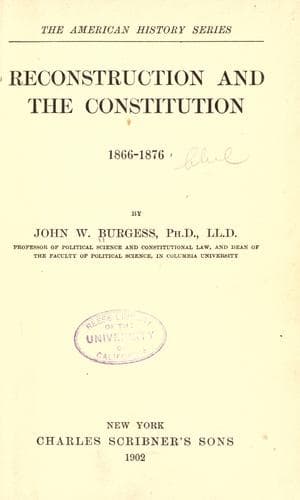
Reconstruction and the Constitution, 1866-1876Burgess, John William
History
Reconstruction and the Constitution, 1866-1876
Burgess, John William
Reconstruction (U.S. history, 1865-1877); United States -- Politics and government -- 1865-1877
In Louisiana, under the leadership of the brilliant young adventurer,
Henry C. Warmoth of Illinois, the financial history of the "State" was
even more scandalous. During the four years of Warmoth's governorship,
from 1868 to 1872, the average annual expenditure of the "State"
government was about six millions of dollars, when, measured by the
previous experiences of the "State," six hundred thousand dollars would
have been ample to defray all legitimate expenses. At the beginning of
Warmoth's administration the debt of the "State" was between six and
seven millions of dollars, with more than enough assets to extinguish
it. At the end of the four years of his power, in 1872, the debt was
nearly fifty millions of dollars, the assets had all disappeared, and
there was nothing worth mentioning to show for the one or the other.
In the counties and municipalities of both "States" the corruption was
equally rampant, shameless, and vulgar. It is impossible to obtain
exact figures in regard to it, or to estimate with any degree of
exactness, or even probability, the amounts stolen and made away with.
In the other reconstructed "States" where the adventurers and the
negroes held sway, the "State" governments worked along the same lines,
though not to the same appalling extent.
It was the most soul-sickening spectacle that Americans had ever been
called upon to behold. Every principle of the old American polity was
here reversed. In place of government by the most intelligent and {264}
virtuous part of the people for the benefit of the governed, here was
government by the most ignorant and vicious part of the population for
the benefit, the vulgar, materialistic, brutal benefit of the governing
set.
[Sidenote: The revolt in the Republican party.]
It is no subject of surprise or wonder that, confronted with these
frightful results of radical Republican policy and administration in
the South, such Republicans as Horace Greeley, Charles Francis Adams,
Lyman Trumbull, David Davis, Carl Schurz, Gratz Brown, Stanley
Matthews, George Hoadly, J. R. Spaulding, George W. Julian, Horace
White, David A. Wells, and the like, turned with disgust from the
nauseating transactions and resolved to do what was in their power to
put an end to it all. Even the radical, but honest, Sumner gave his
adherence to the movement for a change of the Administration, as the
only way to check the terrible corruption which was creeping over the
land. Sumner, it is true, had been made to feel personally the heavy
hand of the Administration. He had been dropped, the preceding year,
from the chairmanship of the Committee on Foreign Relations at the
requirement of the Administration, because he had so strongly and
successfully opposed the Santo Domingo policy of the President and his
"aide-de-camp." But he had opposed that because he saw in it
corruption, robbery and bloodshed.
[Sidenote: The Liberal Republican convention of 1872.]
Public-domain text, read in full here on John Shaqi.
Reviews
Reviews
No reviews yet
Be the first to share your thoughts on this work.
Elsewhere in the archive
Join the Discussion
Join the discussion
Sign in to leave a comment or review.
Sign InorCreate an account