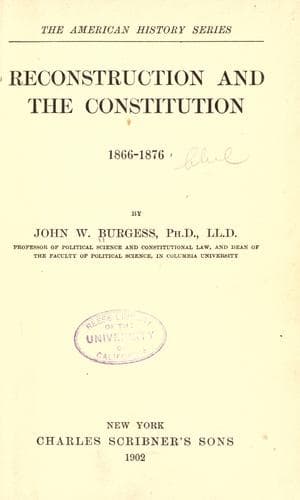
Reconstruction and the Constitution, 1866-1876Burgess, John William
History
Reconstruction and the Constitution, 1866-1876
Burgess, John William
Reconstruction (U.S. history, 1865-1877); United States -- Politics and government -- 1865-1877
The Liberal Republicans were bolters, of course, from the regular
organization, and there was no sufficient opportunity for them to
construct a party organization for themselves in time for the
Presidential election of 1872. A general call for the leaders among
them to meet in mass convention was issued from a "State" convention of
Liberal {265} Republicans in Missouri, and the meeting took place at
Cincinnati on the 1st day of May, 1872.
[Sidenote: Their platform.]
The platform which it presented to the people demanded the removal, at
once, of all political disabilities from the white men of the South,
the maintenance of impartial suffrage and of equal civil rights, the
cessation of military rule in the South and the supremacy of civil over
military power, the reform of the civil service, and a speedy return to
specie payments. Many of the Liberal Republicans were inclined toward a
much more moderate tariff policy, but out of respect for the opinions
of those among them who were strong protectionists, they abandoned
their attempt to insert any doctrine on this subject in the platform.
The protectionists were equally considerate, and so the new party went
to the country uncommitted upon this very important question.
[Sidenote: Their nominees.]
It was at first supposed that the choice of the convention for the
Presidency would lay between Judge David Davis of Illinois, Charles
Francis Adams of Massachusetts and Senator Lyman Trumbull of Illinois.
But an unexpected hostility of a very bitter nature soon developed
between the supporters of Davis and Adams, and rendered the nomination
of either of them impossible. This was evident on the first ballot, on
which Mr. Greeley, Senator Trumbull and Gratz Brown each received more
votes than Judge Davis, and together more votes than Mr. Adams. It was
thus manifest that the Western men would not take Mr. Adams and the
Eastern men would not take Judge Davis. The compromise was quickly made
upon Greeley, and Gratz Brown was put with him upon the ticket. It was
an unfortunate selection. The country did not want any brilliant
experiments at the moment. It wanted to settle down to business. And it
was to be {266} foreseen that it would not be willing to make a
newspaper man President at such a juncture.
[Sidenote: Acceptance of the Liberal Republican candidates by the
Democrats.]
Public-domain text, read in full here on John Shaqi.
Reviews
Reviews
No reviews yet
Be the first to share your thoughts on this work.
Elsewhere in the archive
Join the Discussion
Join the discussion
Sign in to leave a comment or review.
Sign InorCreate an account