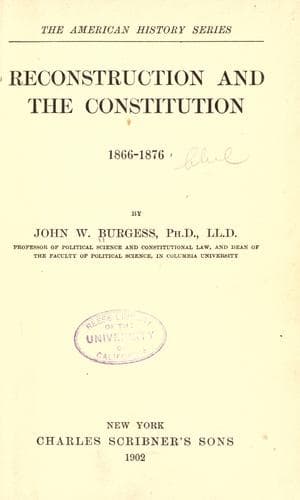
Reconstruction and the Constitution, 1866-1876Burgess, John William
History
Reconstruction and the Constitution, 1866-1876
Burgess, John William
Reconstruction (U.S. history, 1865-1877); United States -- Politics and government -- 1865-1877
After the panic of 1873 had resulted in such a depression of business
and depreciation of values throughout the country as to create greater
discontent with the existing political management, and this discontent
had manifested itself so distinctly in the elections of 1874,
announcing to the Republican party that after March 5th, 1875, a
Democratic majority would prevail in the House of Representatives, it
was manifest to the Republican leaders, in Congress and out of
Congress, that if anything was to be done in regard to the resumption
of specie payment, anything for bringing the paper currency of the
United States up to a coin value, it must be done speedily, and on the
21st of December, 1874, Mr. Sherman reported a bill from the Finance
Committee to the Senate for this purpose, which became a law on the
14th day of January following, and which provided for the redemption of
the fractional currency with silver coins of the value of ten,
twenty-five and fifty cents, so rapidly as these coins could be minted;
abolished the charge of one-fifth of one per centum on the coinage of
gold, making the coinage of gold at the mints of the {278} United
States free; repealed the law limiting the aggregate amount of the
circulating notes of the national banking associations, and the law for
the withdrawal of national-bank currency from, and its redistribution
among, the several "States" and Territories; ordered the Secretary of
the Treasury in issuing new circulating notes to the national banking
associations to retire United States legal tender notes to the amount
of eighty per centum of such issues, until the United States legal
tender notes should be reduced to three hundred millions of dollars,
and after January 1st, 1879, to redeem these legal tender notes in coin
on their presentation at the office of the Assistant Treasurer of the
United States in the city of New York, in sums of not less than fifty
dollars; and, to enable the Secretary of the Treasury to do this,
authorized him to use any unappropriated surplus revenue which might
be, from time to time, in the Treasury, and to sell bonds of the
description mentioned in the Act of July 14th, 1870, in such amounts as
he should find necessary to accomplish the purpose.
[Sidenote: The inflation bill of 1874 and the veto of it by the
President.]
Public-domain text, read in full here on John Shaqi.
Reviews
Reviews
No reviews yet
Be the first to share your thoughts on this work.
Elsewhere in the archive
Join the Discussion
Join the discussion
Sign in to leave a comment or review.
Sign InorCreate an account