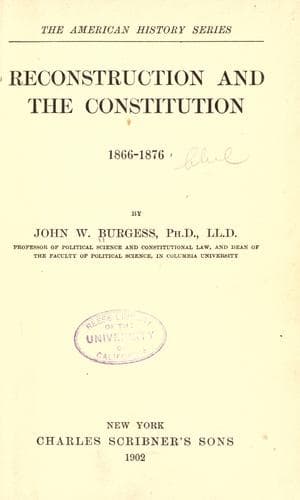
Reconstruction and the Constitution, 1866-1876Burgess, John William
History
Reconstruction and the Constitution, 1866-1876
Burgess, John William
Reconstruction (U.S. history, 1865-1877); United States -- Politics and government -- 1865-1877
It is true that the Republican majority in Congress had not taken this
high ground concerning the public credit and sound money without some
wavering. The President himself had become frightened by the panic of
the autumn of 1873, and in his annual message of December 1st following
had made recommendations that might be regarded as favorable to an
inflation of the existing body of paper money. His party friends in
Congress very soon produced a bill which, among other things, provided
for the increase of the United States notes and the national bank notes
to the extent of about one hundred millions of dollars, and passed it.
But the President had either thought the question out more fully, or
had been in receipt of some very sound {279} advice, after he wrote the
message of December 1st, 1873. On the 22d of April, 1874, he sent a
special message to Congress vetoing the bill. This stand of the
President recalled the Republicans in Congress from their economic
aberrations, and set them again upon the course which led to the Act of
the 14th of January, 1875.
While at the moment this law for the resumption of specie payments in
the short period of four years, or rather less, from the time of its
enactment seemed a rather hazardous, not to say desperate, move on the
part of the Republicans, it soon became manifest that they could have
done nothing so calculated to strengthen the hold of the party upon the
solid and conservative men of the country as just this very thing. Many
of these men who had usually voted with the Republicans disapproved of
the Southern policy of the party, and were on the point of turning
against it. With the Resumption Act the financial policy of the
Republican party, and of the country, was dragged to the front, and the
Southern policy was forced backward, and made to constitute a less
prominent issue in the campaign of 1876. This was not only wise party
management, but it was also a fortunate thing for the entire country.
The country was not yet in a position to endure a Democratic
administration, and, on the other hand, it was surfeited with
reconstruction Republican administrations. It wanted a sound money
Republican administration, which would devote itself to the development
of the economic interests of the whole people, and would let the
"State" governments in the South have a chance to work out their own
salvation. And this was just what it got in the election of 1876, and
in the administration of President Rutherford B. Hayes.
{280}
CHAPTER XIII
THE PRESIDENTIAL ELECTION OF 1876 AND ITS CONSEQUENCES
Public-domain text, read in full here on John Shaqi.
Reviews
Reviews
No reviews yet
Be the first to share your thoughts on this work.
Elsewhere in the archive
Join the Discussion
Join the discussion
Sign in to leave a comment or review.
Sign InorCreate an account