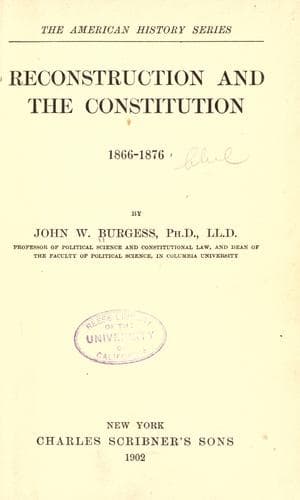
Reconstruction and the Constitution, 1866-1876Burgess, John William
History
Reconstruction and the Constitution, 1866-1876
Burgess, John William
Reconstruction (U.S. history, 1865-1877); United States -- Politics and government -- 1865-1877
While there was no name before the convention commanding universal
popular assent, as had been the case at the second nomination of
Lincoln and the two nominations of Grant, still there was one which, in
so far as its possessor was known, inspired strong, if not
enthusiastic, confidence. It was not pronounced in the first balloting
so loudly as that of the brilliant Blaine, or the stolid Morton, or the
arrogant Conkling, but, as the voting continued, more and more of the
ballots contained it, and at last on the seventh round, it received a
majority of the votes. The choice was a wise one. Mr. Hayes had been a
good soldier, a valuable member of the National legislature, and an
excellent Governor of his native "State," in which office he was
serving for a third term at the time of his nomination for the
Presidency. He was a man of sound sense, unimpeachable character,
generous feeling, pleasing manners, and resolute will. There was a
tendency at first on the part of the friends of some of the
disappointed aspirants to belittle his qualities, and to represent him
as a weak man, and his conciliatory methods were often mistaken for
weakness by those who were not his rivals or his enemies, or the
friends of his rivals or his enemies; but as history sets his character
and his work in their proper perspective they both stand out more and
more strongly, and make his Administration appear to be one of the most
important in American annals. Especially does it honor him for his
earnest, faithful and successful battle for sound money and the
maintenance of the public faith, and for his determination to put an
end to the support by Federal {282} bayonets of the "carpet-bag," negro
"State" governments of the South.
[Sidenote: The National Democratic Convention of 1876.]
[Sidenote: The platform.]
A fortnight after the nomination by the Republican convention of
Rutherford B. Hayes for President and William A. Wheeler for
Vice-President, the Democratic leaders met at St. Louis for the purpose
of issuing the campaign creed of their party and choosing its candidate
for the chief magistracy of the Nation. The platform put forward by
them was remarkable for its length, its language of fierce
vituperation, and its loud calls for reform. Its specific propositions
were the reduction of the duties on foreign imports to a revenue basis,
and the repeal of the Resumption Act of 1875, on the strange ground
that it obstructed the return to specie payments.
[Sidenote: The nominees.]
Public-domain text, read in full here on John Shaqi.
Reviews
Reviews
No reviews yet
Be the first to share your thoughts on this work.
Elsewhere in the archive
Join the Discussion
Join the discussion
Sign in to leave a comment or review.
Sign InorCreate an account