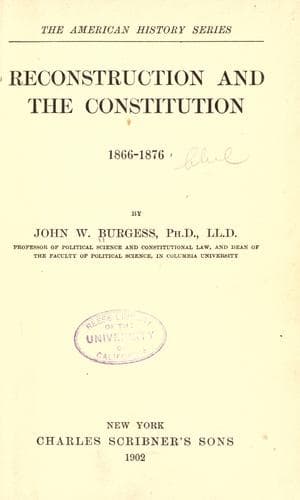
Reconstruction and the Constitution, 1866-1876Burgess, John William
History
Reconstruction and the Constitution, 1866-1876
Burgess, John William
Reconstruction (U.S. history, 1865-1877); United States -- Politics and government -- 1865-1877
Their candidate had virtually been determined on before they met. It
could be nobody else than the popular Governor of New York, Samuel J.
Tilden, shrewd in business, rich, the most successful political manager
New York had produced since Van Buren, greatly heralded as the very
archpriest of reform, the hope of the young men in politics; but not a
statesman in the highest sense of the word, nor a demagogue in the
lowest sense of that word--a genuine American politician of the first
order. He was nominated on the second ballot, and by a unanimous vote.
With him was placed as candidate for the second place the popular Mr.
Hendricks of Indiana. It was a strong ticket, and it was generally
believed that it would win. Mr. Tilden himself felt sure of the
electoral votes of all the Southern "States" and of New York, Indiana,
New Jersey and Connecticut.
[Sidenote: The campaign and the election.]
Mr. Tilden quietly managed his own campaign, while Mr. Hayes left his
political interests in the hands of the {283} very astute chairman of
the National committee of the Republican party, Senator Chandler of
Michigan. There was not much doubt on the morning following the
election, the morning of the 8th November, that the Democrats had
triumphed. Almost all of the Republican newspapers conceded it. But the
Republican managers knew that they could do what they pleased with the
electoral votes of South Carolina, Florida and Louisiana, through their
canvassing boards in these "States," with the power in these boards to
throw out the returns from any place where, in their opinion, there had
been any violence, intimidation, fraud or bribery exercised or
attempted; and when the managers found that they were pretty sure of
the electoral votes of all of the Northern Commonwealths, except
Connecticut, New York, New Jersey and Indiana, they simply added to the
one hundred and sixty-six electoral votes of which they were
practically sure the nineteen votes of Louisiana, Florida and South
Carolina, of which they were absolutely sure, if needed, and sent out
from their head-quarters the positive announcement that Hayes and
Wheeler had been elected by a majority of one electoral vote.
[Sidenote: The count and the twenty-second joint rule.]
Public-domain text, read in full here on John Shaqi.
Reviews
Reviews
No reviews yet
Be the first to share your thoughts on this work.
Elsewhere in the archive
Join the Discussion
Join the discussion
Sign in to leave a comment or review.
Sign InorCreate an account