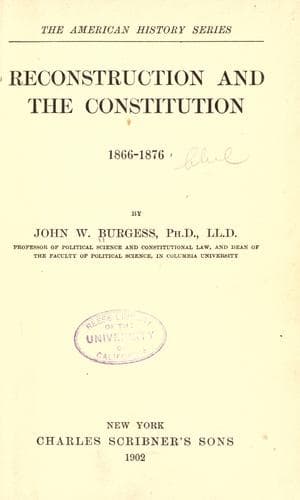
Reconstruction and the Constitution, 1866-1876Burgess, John William
History
Reconstruction and the Constitution, 1866-1876
Burgess, John William
Reconstruction (U.S. history, 1865-1877); United States -- Politics and government -- 1865-1877
The Purchase of Alaska--The Contention of the House of Representatives
in Regard to its Power over Treaties--The Senate's Position and the
Compromise--Irritation of the American People against Great
Britain--The Johnson-Clarendon Treaty--President Grant's Statements in
His First Annual Message and in His Second Annual Address--Sir John
Rose's Mission to the United States--The Joint High Commission--The
Treaty of Washington--The Alabama Claims and the Geneva
Convention--Triumph of the Diplomacy of the United States--Organization
of the Tribunal and Filing of the Cases--The Controversy between Mr.
Fish and Lord Granville--The Filing of the Counter Cases and the
Argument--Obstacles--Decision of the Tribunal in Regard to National and
Indirect Damages--The Decision of the Tribunal in the Case of the
_Florida_--The Decision in the Case of the _Alabama_--The Decision in
the Case of the _Shenandoah_, and other Vessels--International
Principles Settled by the Geneva Tribunal--The Northwest Boundary
Question--The Fisheries Question--The Halifax Commission and Award--The
Burlingame Treaty with China--The Attempt to Annex the Dominican
Republic to the United States--The Treaty--The Treaty before the
Senate--Its Rejection--The President's Attempt to Renew
Negotiations--The Committee of Inquiry--The Report of the
Committee--The Abandonment of the Scheme.
The two chief products of American diplomacy in the decade between 1867
and 1877 were the purchase of Alaska, and the treaty of Washington with
Great Britain.
[Sidenote: The purchase of Alaska.]
The purchase of Alaska, the northwest corner of the North American
continent, together with the islands {300} adjacent thereto, a vast
region of some five hundred thousand square miles in extent, inhabited
chiefly by a few savage tribes, was effected by a treaty, negotiated by
Mr. Seward and the Russian diplomatist, Baron Stoeckl, and ratified by
the Senate of the United States on the 30th of March, 1867.
[Sidenote: The reasons for and against the purchase.]
The proposition came from the side of Russia, and it appeared that
Russia was more eager to sell than the United States was to buy. The
price agreed on was seven millions two hundred thousand dollars in
gold, and most people in the United States thought, at the time, that
this great sum was being paid for nothing but a barren area of snow and
ice. The country was declared to be utterly worthless by some of the
best informed men in Congress, and a man of no less ability and
influence than Mr. Shellabarger opposed the purchase on the ground that
it involved an extension of territory dangerous to the existence of the
Republic.
Public-domain text, read in full here on John Shaqi.
Reviews
Reviews
No reviews yet
Be the first to share your thoughts on this work.
Elsewhere in the archive
Join the Discussion
Join the discussion
Sign in to leave a comment or review.
Sign InorCreate an account