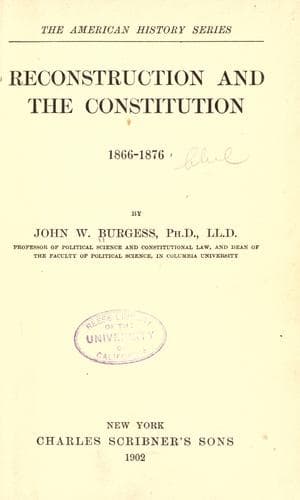
Reconstruction and the Constitution, 1866-1876Burgess, John William
History
Reconstruction and the Constitution, 1866-1876
Burgess, John William
Reconstruction (U.S. history, 1865-1877); United States -- Politics and government -- 1865-1877
On the other hand, such men as General Banks and Mr. Stevens contended
that from the point of view of a business transaction alone it was
worth the money; and Mr. Higby, of California, told his colleagues that
they were mistaken in regard to the climate of the region. The
consideration, however, which seems to have had most weight was
gratitude toward Russia, whose government had manifested the most
friendly feeling for the Union in the struggle against the giant
rebellion, and had even threatened interference in behalf of the Union
against interference in behalf of the Confederacy by any other European
state. That acute observer of political opinion, Mr. Blaine, affirmed
that a like offer from any other European government would most
probably have been declined.
{301} [Sidenote: A real political reason for the purchase.]
It is, however, almost certain that Mr. Seward had another very
profound reason for making the purchase, one which he could not very
well proclaim from the housetops, especially as the feeling on his
part, and on the part of the Government and of the people of the North,
was most kindly toward Russia. It was this: The United States would in
this way and at a comparatively small cost rid herself forever of any
danger of Russian colonization on the North American continent, and of
the danger of any complications between Russia and Great Britain upon
this continent. This was a most important political consideration, one
which much overbalanced the price paid for the territory and the cost
of its administration.
[Sidenote: The contention of the House of Representatives in regard to
its power over treaties involving the payment of money by the United
States.]
When the bill for making the appropriation to pay for Alaska came
before the House of Representatives, that body raised the question of
the power of the House over treaties involving the payment of money by
the United States, by asserting in the preamble of the bill that its
consent was necessary to the validity of such treaties. It did so on
the ground that as an independent legislative body it could refuse any
appropriation at its own discretion, and that as all foreign countries
were bound to know this from the wording of the Constitution, no
foreign country could consider a treaty with the United States,
involving financial obligations by the United States, as completed
until the House of Representatives should have voted the appropriation
of the amount stipulated in the agreement.
[Sidenote: The Senate's position and the compromise.]
Public-domain text, read in full here on John Shaqi.
Reviews
Reviews
No reviews yet
Be the first to share your thoughts on this work.
Elsewhere in the archive
Join the Discussion
Join the discussion
Sign in to leave a comment or review.
Sign InorCreate an account