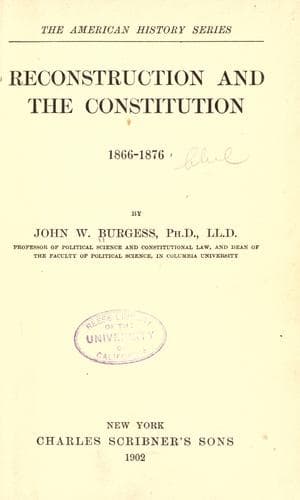
Reconstruction and the Constitution, 1866-1876Burgess, John William
History
Reconstruction and the Constitution, 1866-1876
Burgess, John William
Reconstruction (U.S. history, 1865-1877); United States -- Politics and government -- 1865-1877
[Sidenote: The Johnson-Clarendon treaty.]
Before, however, the discussion had fairly begun Mr. Adams returned to
the United States, and Mr. Reverdy Johnson was sent out to the British
Court. Mr. Johnson yielded much of the ground assumed by Mr. Adams in
reference to claims for national injury, and in January of 1869
concluded an agreement with the Earl of Clarendon for submitting to
arbitration the claims for direct damage to property rights.
[Sidenote: President Grant's statement in his first Annual Message.]
The Senate of the United States promptly rejected the treaty with much
feeling, because it did not contain proper provision, in its view, for
the reparation of wrongs to the Nation. The feeling among the people of
both countries ran so high that the Governments deemed it wise to
cease, for a time, negotiations upon the subject. The new President,
Grant, in his Message of December 6th, 1869, described the situation in
the following language:
{304} "Toward the close of the last Administration a convention was
signed in London for the settlement of all outstanding claims between
Great Britain and the United States, which failed to receive the advice
and consent of the Senate to its ratification. The time and the
circumstances attending the negotiation of that treaty were unfavorable
to its acceptance by the people of the United States, and its
provisions were wholly inadequate for the settlement of the grave
wrongs that had been sustained by this Government, as well as by its
citizens. The injuries resulting to the United States by reason of the
course adopted by Great Britain during our late Civil War in the
increased rates of insurance, in the diminution of exports and imports
and other obstructions to domestic industry and production, in its
effect upon the foreign commerce of the country, in the decrease and
transfer to Great Britain of our commercial marine, in the prolongation
of the war and the increased cost, both in treasure and lives, of its
suppression, could not be adjusted and satisfied as ordinary commercial
claims which continually arise among commercial nations; and yet the
convention treated them as such ordinary claims, from which they differ
more widely in the gravity of their character than in the magnitude of
their amount, great even as is that difference. Not a word was found in
the treaty, and not an inference could be drawn from it, to remove the
sense of the unfriendliness of the course of Great Britain in our
struggle for existence, which had so deeply and universally impressed
itself upon the people of this country. Believing that a convention
thus misconceived in its scope and inadequate in its provisions would
not have produced the hearty, cordial settlement of pending questions,
which alone is consistent with the relations which I desire to have
firmly established {305} between the United States and Great Britain, I
regarded the action of the Senate in rejecting the treaty to have been
Public-domain text, read in full here on John Shaqi.
Reviews
Reviews
No reviews yet
Be the first to share your thoughts on this work.
Elsewhere in the archive
Join the Discussion
Join the discussion
Sign in to leave a comment or review.
Sign InorCreate an account