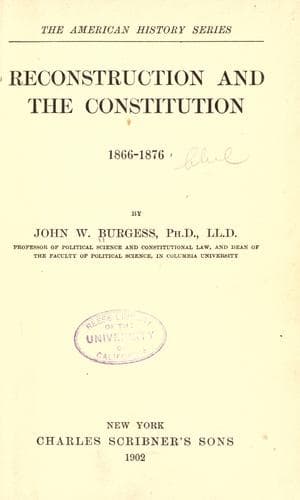
Reconstruction and the Constitution, 1866-1876Burgess, John William
History
Reconstruction and the Constitution, 1866-1876
Burgess, John William
Reconstruction (U.S. history, 1865-1877); United States -- Politics and government -- 1865-1877
The Senate, on the other hand, repudiated this doctrine, and rejected
the bill with the preamble containing it as it came from the House of
Representatives. {302} The bill then went to a conference committee of
the two Houses, and this committee invented a preamble which read:
"Whereas the President has entered into a treaty with the Emperor of
Russia, and the Senate thereafter gave its advice and consent to said
treaty, and whereas said stipulations cannot be carried into full force
and effect, except by legislation to which the consent of both Houses
of Congress is necessary; therefore be it resolved," etc. Both Houses
adopted the bill in this form and it became law July 27th, 1868.
The contention of the House was good political science, but it is still
doubtful whether it is the constitutional law of the United States or
not. The more recent constitutions of even the European states, such as
those of Germany and France, make the consent of both houses of the
legislature necessary to the validity of all treaties involving the
appropriation of money, or the assumption of any financial obligation.
This is as it should be; and the Constitution of the United States
ought to be so amended as to establish clearly the same principle.
[Sidenote: Irritation of the American people against Great Britain.]
[Sidenote: Change of Ministry and Parliamentary majority in 1867.]
We have, in the preceding volume of this series, followed the history
of the relations of the United States with Great Britain down to the
close of the rebellion, and have referred to the general irritation on
the part of the loyal people of the United States against the British
government for its attitude in regard to the acts of its subjects in
furnishing warships and munitions to the Confederates. There were many
who favored turning the great military power with which the United
States emerged from the Civil War against Great Britain, and forcing a
settlement of those difficulties by the trial of arms; but Seward
remained in the direction of the foreign affairs of the Union, and he
had had enough of war. Moreover, he {303} foresaw a change of
government in Great Britain, and with it he hoped for a change of
sentiment on the part of the new government on the international
question. This event happened in consequence of the parliamentary
election of 1867. The Minister of Foreign Affairs in Mr. Gladstone's
cabinet was first Lord Stanley, and then the Earl of Clarendon, both of
them very different in character from Lord John Russell. From the
outset each of them manifested a sincere desire to reach an amicable
settlement of all differences with the United States. The trouble at
this juncture seems to have been the extravagance of the claims of the
United States. Mr. Adams, whose patience had become much worn, talked
about private damages, national damages and an apology. The British
Ministers thought this too preposterous to be seriously meant.
Public-domain text, read in full here on John Shaqi.
Reviews
Reviews
No reviews yet
Be the first to share your thoughts on this work.
Elsewhere in the archive
Join the Discussion
Join the discussion
Sign in to leave a comment or review.
Sign InorCreate an account