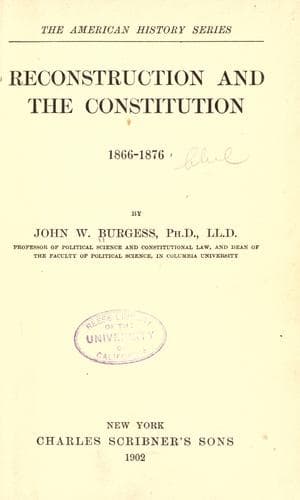
Reconstruction and the Constitution, 1866-1876Burgess, John William
History
Reconstruction and the Constitution, 1866-1876
Burgess, John William
Reconstruction (U.S. history, 1865-1877); United States -- Politics and government -- 1865-1877
It is true that Her Majesty's Government qualified its acceptance of
the rules to be applied in determining its responsibility by inserting
an explanation in the Treaty of the following tenor: "Her Britannic
Majesty has commanded her High Commissioners and Plenipotentiaries to
declare that Her Majesty's Government cannot assent to the foregoing
rules as a statement of principles of international law which were in
force at the time when the claims mentioned in Article I. arose, but
that Her Majesty's Government, in order to evince its desire of
strengthening the friendly relations between the two countries and of
making satisfactory provision for the {311} future, agrees that, in
deciding the questions between the two countries arising out of those
claims, the Arbitrators should assume that Her Majesty's Government had
undertaken to act upon the principles set forth in these rules."
And it is also true that, while, according to the letter of the Treaty,
the United States Government was left unfettered as to the character of
the claims which it might lay before the Arbitrators, Her Majesty's
Government had been led to expect more moderation in this respect than
the popular sentiment in the United States seemed to indicate.
[Sidenote: The arbitrators, agents and counsel.]
The two Governments and the high personages invited by them proceeded
in due time to appoint the Arbitrators. The President of the United
States appointed Mr. Charles Francis Adams; Her Majesty named Chief
Justice Alexander Cockburn; the Italian King designated Count Frederic
Sclopis; the President of the Swiss Confederation designated Mr. Jacob
Staempfli, and the Emperor of Brazil named the Baron d'Itajubá.
The President of the United States also appointed Mr. J. C. Bancroft
Davis as the agent of the United States before the Tribunal, and Mr.
Caleb Cushing, Mr. William M. Evarts and Mr. Morrison R. Waite as
counsel.
Her Majesty's Government also appointed Lord Tenterden as the agent of
Great Britain before the Tribunal, and Sir Roundell Palmer as chief
counsel.
[Sidenote: Organization of the Tribunal and filing of the cases.]
On the 15th of December, 1871, the Arbitrators organized the Tribunal
at Geneva with Count Frederic Sclopis in the chair as presiding
officer, and with Mr. Alexander Favrot as secretary. The printed case
of each of the high contracting parties was filed immediately by the
agent of each, and the Tribunal ordered the counter cases to be filed
{312} on or before the 15th day of the following April. The Tribunal
then adjourned to June 15th following, unless sooner called together by
the secretary.
[Sidenote: The controversy between Mr. Fish and Lord Granville.]
Public-domain text, read in full here on John Shaqi.
Reviews
Reviews
No reviews yet
Be the first to share your thoughts on this work.
Elsewhere in the archive
Join the Discussion
Join the discussion
Sign in to leave a comment or review.
Sign InorCreate an account