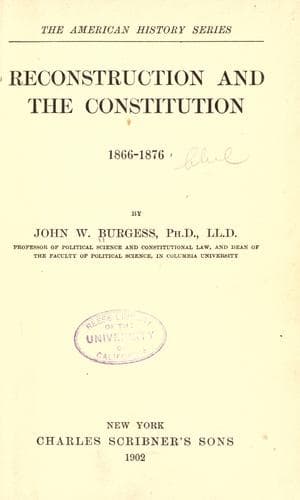
Reconstruction and the Constitution, 1866-1876Burgess, John William
History
Reconstruction and the Constitution, 1866-1876
Burgess, John William
Reconstruction (U.S. history, 1865-1877); United States -- Politics and government -- 1865-1877
The contents of the case of the United States became immediately known
to the British Ministers, but not for some weeks to the British people.
The Ministers were not apparently disturbed in mind about it, although
they discovered at once that it contained claims for national damages
and indirect damages as well as for direct damages to individuals; but
as soon as the newspapers got hold of this fact, they raised a
tremendous hue and cry, and accused those who had prepared the case of
taking an unfair advantage of the wording of the treaty. The Minister
of the United States in London, General Schenck, informed Mr. Fish by
cable of the agitation in London over the subject and of the demand of
the newspapers that the claim for national and indirect damages should
be withdrawn. Mr. Fish replied firmly that "there must be no withdrawal
of any part of the claim presented." At this moment the session of
Parliament opened and the Queen's speech contained a criticism of the
extravagance of the claims of the United States in the case submitted
to the Tribunal. The matter was warmly debated in Parliament, and on
February 3d the British Foreign Minister, Lord Granville, opened a
diplomatic discussion with Mr. Fish upon the subject. Mr. Fish,
however, held his ground with great courage and ability, insisting that
the claims of every character should be disposed of by the Tribunal in
order to remove them from the domain of further controversy and in
order to establish perfect harmony in the relations of the two
countries.
[Sidenote: The filing of the counter cases and the argument.]
Before this discussion terminated the day arrived for the filing of the
counter cases. They were both {313} promptly filed with a reservation
of all rights by each of the high contracting parties. The diplomatic
discussion culminated in an attempt to make a supplemental treaty,
which should provide that the Government of the United States should
withdraw its claims for national losses and indirect losses, on the
condition that no such losses should be claimed by either Government in
the future. But the day arrived for the filing of the arguments before
anything was effected. The agent of the United States filed his
argument on the day fixed, the 15th of June, but the British agent only
filed a statement setting forth the differences between the two
Governments in the interpretation of the Treaty in respect to claims
for national and indirect damages, and the late negotiations and
discussions between the two Governments concerning these differences.
The British agent also expressed the hope that, if time were given,
these negotiations would prove fruitful, and asked the Arbitrators to
adjourn for eight months.
[Sidenote: Obstacles.]
[Sidenote: Decision of the Tribunal in regard to national and indirect
damages.]
Public-domain text, read in full here on John Shaqi.
Reviews
Reviews
No reviews yet
Be the first to share your thoughts on this work.
Elsewhere in the archive
Join the Discussion
Join the discussion
Sign in to leave a comment or review.
Sign InorCreate an account