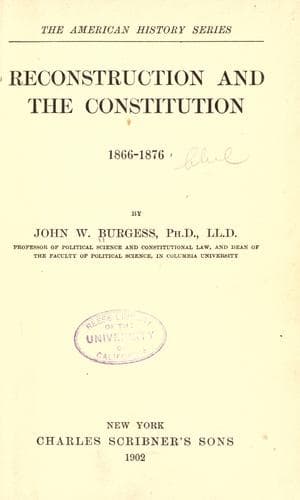
Reconstruction and the Constitution, 1866-1876Burgess, John William
History
Reconstruction and the Constitution, 1866-1876
Burgess, John William
Reconstruction (U.S. history, 1865-1877); United States -- Politics and government -- 1865-1877
As to principles decided by the entire procedure of the commissioners
and of their Governments in the formation of the Treaty, and of the
Arbitrators in making the award, we may say, first, that all questions
of damages resulting from the lack of due diligence on the part of a
neutral in the fulfilment of the duties of neutrality were regarded as
proper subjects for arbitration, and that the determination of the
question whether the claims presented, or any of them, are a good
foundation for an award of compensation was also regarded as a proper
question for arbitration; second, that due diligence to be exercised by
neutral governments is diligence "in exact proportion to the risks to
which either of the belligerents may be exposed from a failure to
fulfil the obligations of neutrality on their part"; third, that the
fact that a commission was only subsequently given by a belligerent to
a vessel constructed, equipped or armed for the belligerent in the port
of the neutral does not heal the violation of the duties of neutrality
by the neutral in not using due diligence to prevent such construction,
equipment or armament in its ports; fourth, that the privilege of
ex-territoriality accorded to vessels of war can never be appealed to
for the protection of acts done in violation of neutrality; fifth, that
no neutral can excuse itself from the due discharge of the duties of
neutrality on account of imperfections in its own laws and government;
and sixth, that the cost to the belligerent of pursuing vessels, which
have been enabled to operate against the belligerent on account of the
dereliction of the neutral, and all indirect loss resulting therefrom,
do not constitute a "good foundation for an {319} award of compensation
or computation of damages between nations."
[Sidenote: The Northwest boundary question.]
Two other questions of great importance were placed in course of
solution by the Treaty of Washington. One was the contention between
the two high contracting parties concerning the boundary line between
the United States and British Columbia from the point where the
forty-ninth parallel of north latitude intersects the middle of the
channel which separates the continent from Vancouver's Island to the
Pacific Ocean. The contention on the part of Great Britain was that
this line should run, according to the stipulations of the Treaty of
June 15th, 1846, through the Rosario Straits, and on the part of the
United States that it should run through the Canal de Haro. The high
contracting parties agreed, in the thirty-fourth article of the Treaty
of Washington, to submit this question to the arbitration and award of
His Majesty the German Emperor, whose decision thereon should be final
and without appeal. The German Emperor, William I., accepted this duty;
and on the 21st of October, 1872, announced his award, upholding the
contention of the United States.
[Sidenote: The Fisheries question.]
Public-domain text, read in full here on John Shaqi.
Reviews
Reviews
No reviews yet
Be the first to share your thoughts on this work.
Elsewhere in the archive
Join the Discussion
Join the discussion
Sign in to leave a comment or review.
Sign InorCreate an account