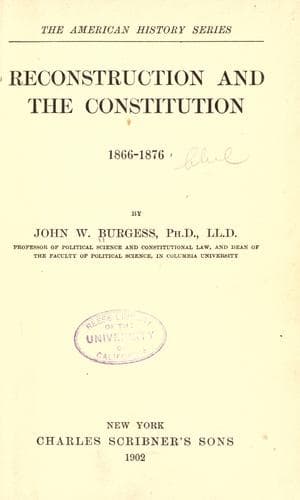
Reconstruction and the Constitution, 1866-1876Burgess, John William
History
Reconstruction and the Constitution, 1866-1876
Burgess, John William
Reconstruction (U.S. history, 1865-1877); United States -- Politics and government -- 1865-1877
The other question was that which related to the common rights of
fishing to be enjoyed by the citizens and subjects of the two high
contracting parties along the Atlantic coast. The eighteenth article of
the Treaty provided that the inhabitants of the United States should
have for the term of twelve years, in common with the subjects of Her
Britannic Majesty, the right to take sea fish "of every kind, except
shell-fish, on the sea-coasts and shores, and in the bays, harbors, and
creeks, of the Provinces of Quebec, Nova Scotia, and New Brunswick, and
the colony of Prince Edward's Island, and of the several islands {320}
thereunto adjacent, without being restricted to any distance from the
shore, with permission to land upon the said coasts and shores and
islands, and also upon the Magdalen Islands, for the purpose of drying
their nets and curing their fish." By article nineteenth the same right
was accorded to British subjects, in common with the citizens of the
United States, along "the eastern sea-coasts and shores of the United
States north of the thirty-ninth parallel of north latitude, and on the
shores of the several islands adjacent thereunto, and in the bays,
harbors and creeks of the said sea-coasts and shores of the United
States and of the said islands." Finally, by article twenty-first free
trade between Canada and Prince Edward's Island and the United States
in the produce of their respective sea-fisheries was established.
[Sidenote: The Halifax commission and award.]
The contention on the part of Great Britain in regard to this subject
was that the rights and privileges accorded to the citizens of the
United States by these articles were more valuable than those conceded
to the subjects of Great Britain by the United States, and that a sum
of money should be paid to Great Britain by the United States in offset
thereof. The United States denied the British assumption, and the two
high contracting parties agreed, in the twenty-third article of the
Treaty, to leave this matter to the arbitration and award of three
commissioners, one to be appointed by the President of the United
States, one by Her Britannic Majesty, and a third by the President and
the Queen conjointly, provided they could agree upon a person within
three months from the date when the Treaty should take effect and, if
not, then by the Austro-Hungarian Ambassador at the Court of St. James.
Public-domain text, read in full here on John Shaqi.
Reviews
Reviews
No reviews yet
Be the first to share your thoughts on this work.
Elsewhere in the archive
Join the Discussion
Join the discussion
Sign in to leave a comment or review.
Sign InorCreate an account