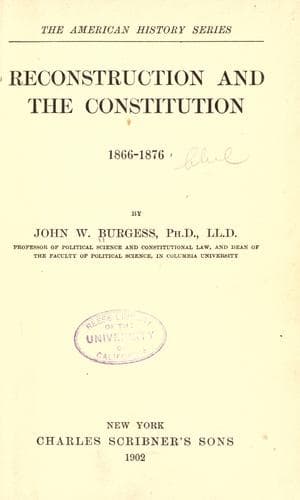
Reconstruction and the Constitution, 1866-1876Burgess, John William
History
Reconstruction and the Constitution, 1866-1876
Burgess, John William
Reconstruction (U.S. history, 1865-1877); United States -- Politics and government -- 1865-1877
There is no question that in sound political science the House was
entirely correct in its theory, and that the objection of the Senate to
that part of the Stevens resolution which provided that no member
should be received into either House from any of the so-called
Confederate States until the report of the Committee on Reconstruction
should have been finally acted on by Congress, as trenching upon the
exclusive power of the Senate to judge of the elections, returns and
qualifications of its members, rested upon a confounding of the {44}
function of Congress to admit "States" into the Union with the power of
each House to judge of the elections, returns and qualifications of
those claiming to represent "States" or constituencies in "States"
about whose position in the Union there was no question. The Senate
finally swung into line, however, by passing this part of the House
resolution as a concurrent resolution instead of as a joint resolution.
[Sidenote: Legislation of the reconstructed "States" concerning the
status of the freedmen, and the Freedmen's Bureau.]
There were two other considerations which moved the Republicans in
Congress to assume this attitude in regard to Reconstruction. One was
the legislation of the "States" reconstructed by the President
concerning the status and the rights of the freedmen. On the 3d of
March preceding, Congress had passed an act organizing a bureau in the
War Department for the care of refugees and freedmen in the districts
in rebellion or in the territory embraced in the operations of the
army. This bureau was officered by a chief commissioner and assistant
commissioners for each of the "States" declared to be in insurrection.
These officers were authorized to take possession of the abandoned
lands within these "States," and other lands belonging to the United
States, and parcel them out to the loyal male refugees and freedmen,
not more than forty acres to each, and protect them in the use and
enjoyment of the same for the term of three years. They were also
authorized to issue under the direction of the Secretary of War
provisions, clothing and fuel to such loyal refugees and freedmen as
were destitute.
[Sidenote: The administration of the Freedmen's Bureau.]
Public-domain text, read in full here on John Shaqi.
Reviews
Reviews
No reviews yet
Be the first to share your thoughts on this work.
Join the Discussion
Join the discussion
Sign in to leave a comment or review.
Sign InorCreate an account