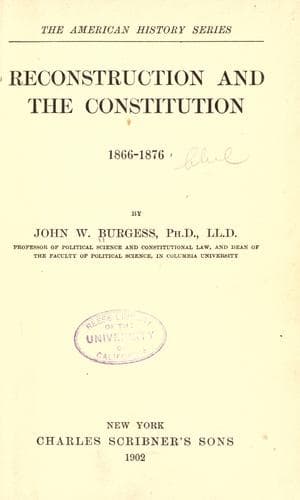
Reconstruction and the Constitution, 1866-1876Burgess, John William
History
Reconstruction and the Constitution, 1866-1876
Burgess, John William
Reconstruction (U.S. history, 1865-1877); United States -- Politics and government -- 1865-1877
The Mississippi acts were all passed in November. They were the acts
which were before the view of Congress and the country in the beginning
of December, 1865, and, with the exception of the South Carolina
Preliminary Act just commented on, the only ones. They require,
therefore, a somewhat fuller treatment. They consist of "An Act to
regulate the relation of master and apprentice relative to Freedmen,
Free Negroes, and Mulattoes, passed November 22, 1865"; the "Vagrant
Act of November 24, 1865"; an "Act to Confer Civil Rights on Freedmen
and for other purposes," passed November 25, 1865; a supplementary Act
to this, passed November 29, 1865; and another supplementary Act,
passed December 2, 1865.
The first Act provided that freedmen, free negroes, and mulattoes under
the age of eighteen years, being orphans, or the children of parents
who could not, or would not, support them, should be apprenticed by the
clerk of the Probate court in the county where found to competent and
suitable persons, and on such terms as the court should direct; under
the restrictions, that the former owner of the minor should be selected
by the court as the master or mistress if, in the judgment of the
court, he or she were competent and suitable; that the terms fixed by
the court should have the interest of the minor particularly in view;
and that the apprentice should be bound by indenture, to run, in the
case of males, until the completion of the twenty-first year, {48} and,
in the case of females, until the completion of the eighteenth year.
This Act further provided that in the management and control of
apprentices, the master or mistress should "have power to inflict such
moderate corporal chastisement as a father or guardian is allowed to
inflict on his or her child or ward at common law," but that in no case
should "cruel or inhuman punishment be inflicted."
It furthermore provided, that in case of desertion by the apprentice,
he might be apprehended and brought before a justice of the peace, who
might remand him to his master or mistress, and might, on the refusal
of the apprentice to return, commit him to jail, on failure to give
bond, until the next term of the County court, which court should
inquire into the matter, and determine whether the apprentice had left
the service to which he was bound without good cause or not, and
should, in the one case, compel the return to service by ordering the
infliction of the necessary penalties, and in the other, should order
the discharge of the apprentice, and enter "judgment against the master
or mistress for not more than one hundred dollars, for the use and
benefit of the apprentice."
Public-domain text, read in full here on John Shaqi.
Reviews
Reviews
No reviews yet
Be the first to share your thoughts on this work.
Join the Discussion
Join the discussion
Sign in to leave a comment or review.
Sign InorCreate an account