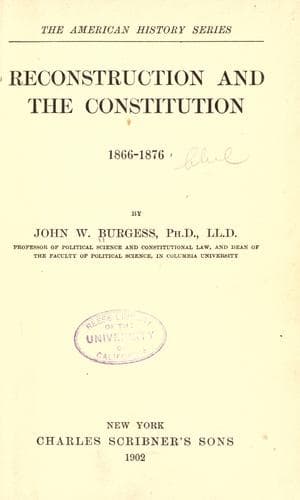
Reconstruction and the Constitution, 1866-1876Burgess, John William
History
Reconstruction and the Constitution, 1866-1876
Burgess, John William
Reconstruction (U.S. history, 1865-1877); United States -- Politics and government -- 1865-1877
It is to be remarked, however, that had he counted none of the "States"
that had passed secession ordinances, either in the whole number, or in
the three-quarters necessary to adopt, the Amendment would in that case
also have been adopted. There would have been, in that case,
twenty-five "States" in the Union, and of these nineteen had adopted
the Amendment. And if any controversy had arisen over the use of
fractions in making nineteen three-fourths of twenty-five, this would
have been quickly overcome by the fact that the legislatures of four
more of the loyal "States" adopted the Amendment soon after Mr.
Seward's declaration, making twenty-three out of twenty-five. It will
not, of course, be disputed that, if the "States" that passed secession
ordinances should have been counted in arriving at the whole number of
"States" in the Union, those of them adopting the Amendment should also
have been counted in making out the three-fourths majority {56}
necessary to adoption, and that if, on the other hand, they should have
been excluded in arriving at the whole number, they should also have
been excluded in making up the three-fourths majority. In other words,
it does not matter from which point of view we regard the subject, the
Amendment was regularly and lawfully adopted. It must be admitted,
however, that Mr. Seward followed in this most solemn procedure, the
amending of the Constitution, the Presidential plan of Reconstruction,
and gave great encouragement to the Senators- and Representatives-elect
from these reconstructed "States" to expect that they would have the
aid and influence both of the Democrats in Congress, and of the
Administration, in securing their seats.
[Sidenote: The demand of the Senators- and Representatives-elect from
the reconstructed "States" to be admitted to seats in Congress.]
They had gone to Washington and, bearing themselves confidently from
the first, they now became defiant in demanding their rights. Many of
them were men who, less than twelve months before, had been in arms
against the United States, and one of them was the person who was the
Vice-President of the Confederacy at the moment of its downfall, Mr.
Alexander H. Stephens. Such an attitude on his part and their part
roused again great bitterness of feeling among the Republicans, many of
whom conscientiously thought that the real deserts of such persons were
the penalties of treason. Moreover, the legislatures of some of the
other "States" reconstructed under the President's plan enacted, during
December, January and February, measures concerning the status and
rights of the emancipated slaves similar to those passed by the
legislature of Mississippi, and in some respects even more illiberal
than those passed by that body; and it was evident that all of them
would finally stand upon the same general ground in regard to this
subject.
Public-domain text, read in full here on John Shaqi.
Reviews
Reviews
No reviews yet
Be the first to share your thoughts on this work.
Join the Discussion
Join the discussion
Sign in to leave a comment or review.
Sign InorCreate an account