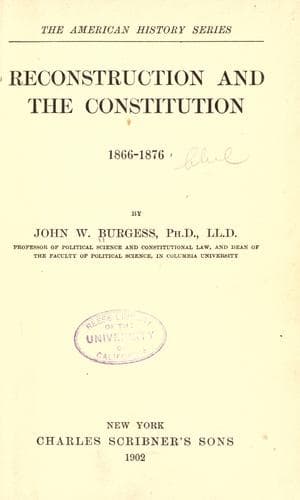
Reconstruction and the Constitution, 1866-1876 — John Shaqi
Reconstruction and the Constitution, 1866-1876Burgess, John William
History
Reconstruction and the Constitution, 1866-1876
Burgess, John William
Reconstruction (U.S. history, 1865-1877); United States -- Politics and government -- 1865-1877
On the evening of the 22d of February, three days after his successful
veto, the President made a most important speech from the steps of the
White House to a large popular meeting assembled to congratulate him
upon his victory. He was betrayed by his elation and warmth into an
abusive denunciation of his enemies, once, and only a few months
before, his best friends. He went so far as to declare that Stevens and
Sumner and Phillips and others like them were, in his opinion, laboring
as assiduously to destroy the fundamental principles of the government
as were the leaders of the rebellion. After such an open challenge, the
contest was nearly unavoidable. It was not avoided, whatever might have
been the possibilities of re-establishing harmony. And it cannot be
denied that, from this moment, personal rancor against the President
filled the heart of Stevens, at least, if not of the others. The
President's utterances were, indeed, highly exasperating, and it would
have required a very large measure of public virtue to have ignored
them.
{68} [Sidenote: The Civil Rights Bill.]
As a part of the same plan for securing the civil rights of the
freedmen against the hostile legislation of the President's
reconstructed "States," the Judiciary Committee of the Senate reported
a Civil Rights bill to the Senate one day before it reported the
Freedmen's Bureau bill, that is, on the 11th of January. The right of
way, so to speak, was, however, given to the latter bill, and Congress
was nearly two months longer in perfecting the former than the latter.
This Civil Rights bill certainly avoided many of the most serious
objections which could be truthfully made against the Freedmen's Bureau
bill. It was not a war measure in a time of peace. It did not provide a
privileged jurisdiction for any class, and it did not create an army of
new officials to drain the Treasury and increase the patronage of the
President.
Public-domain text, read in full here on John Shaqi.
Reviews
Reviews
No reviews yet
Be the first to share your thoughts on this work.
Join the Discussion
Join the discussion
Sign in to leave a comment or review.
Sign InorCreate an account