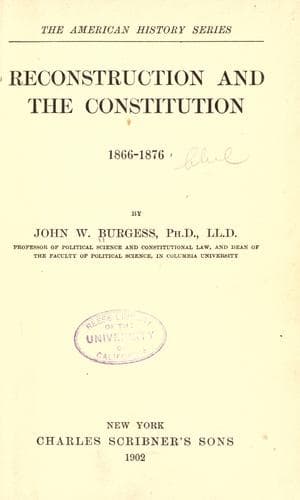
Reconstruction and the Constitution, 1866-1876Burgess, John William
History
Reconstruction and the Constitution, 1866-1876
Burgess, John William
Reconstruction (U.S. history, 1865-1877); United States -- Politics and government -- 1865-1877
The President had on the 20th day of August, a week before setting out
upon his tour, finally proclaimed the insurrection and Civil War at an
end in every part of the country. He had, on the 2d day of April
preceding, declared the insurrection at an end everywhere except in
Texas, and the proclamation of August 20th gave official witness to its
cessation in Texas. It is certainly a prerogative of the President to
proclaim the cessation of opposition to his execution of the laws of
the Union, and then to execute the same thereafter through civil,
instead of military, officers. If the President had meant no more than
this by his proclamations of the termination of the insurrection, the
position would have been unassailable. But he evidently intended his
proclamations as furnishing a basis for his Reconstruction work, or at
any rate as furnishing a great reason for the general recognition of
the validity of that work. This we can easily gather from the speeches
he made as he "swung around the circle" in the campaign of 1866. He
felt that he had solid ground under his feet, and did not appreciate
the fact that he was resting one of his doctrines upon another, the
latter being no more self-evident than the former. He felt quite sure
of victory, until what were called the "October States," at that time,
Pennsylvania, Ohio, Indiana and Iowa, held their elections. The two
"September States," Vermont and Maine, had largely increased their
Republican majorities, which the President had probably expected and
allowed for, but when the four "October States" gave only twelve seats
in the House of Representatives to the Democrats and nearly fifty to
the Republicans, it was pretty clearly revealed {104} that the
Administration was on the eve of a terrible defeat. It was as
overwhelming as these figures indicated. The final results showed that
the Republicans had elected one hundred and forty-three of their
candidates to seats in the House of Representatives, while the
Democrats had succeeded in securing only forty-nine seats. With the
exception of Delaware, Maryland and Kentucky, all the "States"
represented in Congress had given the Republican party strong
majorities. The strength of the Democratic party was again in the
South, where the Democratic candidates for any kind of office had
almost universally succeeded. In the Senate the Republicans constituted
more than a two-thirds majority of the members, and with their almost
three-fourths majority in the House, there could be no question that,
in a contest between the President and Congress, the former would be
obliged to yield.
[Sidenote: The President's Message of December 3d, 1866.]
Public-domain text, read in full here on John Shaqi.
Reviews
Reviews
No reviews yet
Be the first to share your thoughts on this work.
Elsewhere in the archive
Join the Discussion
Join the discussion
Sign in to leave a comment or review.
Sign InorCreate an account