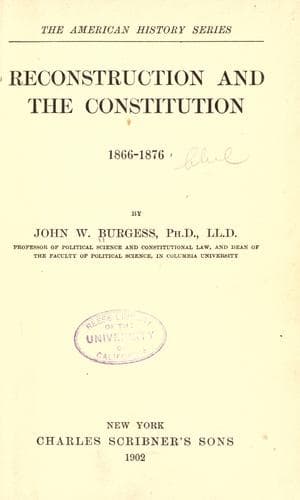
Reconstruction and the Constitution, 1866-1876Burgess, John William
History
Reconstruction and the Constitution, 1866-1876
Burgess, John William
Reconstruction (U.S. history, 1865-1877); United States -- Politics and government -- 1865-1877
Notwithstanding all this, however, the President, in his Message to
Congress of December 3d, returned to the contest. He reargued his case
from every point of view, and with both moderation and great force. He
restated what had been done toward Reconstruction, declaring that peace
had been restored everywhere, that all the laws of the United States
and all the machinery of the United States Government were in unimpeded
operation everywhere throughout the length and breadth of the land, and
that loyal "State" governments had been restored everywhere, and lacked
but one thing of completion, viz., the admission of Representatives and
Senators from ten of the eleven "States" in which secession ordinances
had been passed to seats in Congress. He contended that all the
departments of the United States Government had proceeded upon the view
that the "States" were indestructible--the Congress, in the {105}
declaration, at the outset, that the war was not to be waged in any
spirit of oppression, nor for any purpose of conquest or subjugation,
nor purpose of overthrowing or interfering with the rights or
established institutions of the "States" which were the scene of
rebellion, but to defend and maintain the supremacy of the Constitution
and all laws made in pursuance thereof, and to preserve the Union, with
all the dignity, equality, and rights of the several States unimpaired,
and in many other acts and resolutions; the Judiciary, in all
proceedings affecting the reconstruction communities as "States"; and
the Executive, in the entire plan of Reconstruction created by Mr.
Lincoln and followed out by himself. He further contended that in
recognizing these "States" as restored to their former relations,
Congress was not running any risk of having disloyal men thrust into
the legislative chambers of the nation, because each House of Congress
could reject members-elect on account of disloyalty, and could continue
to reject until the constituencies should send up such persons as the
House could approve, and could expel any member whose conduct should
reveal disloyalty. He therefore urged Congress to acknowledge the
Reconstruction of the "States" lately in rebellion, in principle, and
to apply the powers of the two Houses in regard to the elections,
returns and qualifications of their respective members to the
individual persons elected to seats.
[Sidenote: Ineffectiveness of the President's argument.]
[Sidenote: Rejection of the proposed Fourteenth Amendment by the
legislatures of the Reconstructed "States."]
[Sidenote: The effect of this on the temper of the North.]
Public-domain text, read in full here on John Shaqi.
Reviews
Reviews
No reviews yet
Be the first to share your thoughts on this work.
Elsewhere in the archive
Join the Discussion
Join the discussion
Sign in to leave a comment or review.
Sign InorCreate an account