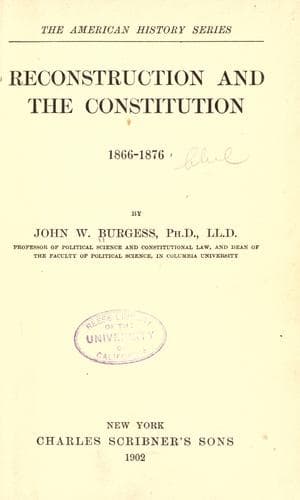
Reconstruction and the Constitution, 1866-1876Burgess, John William
History
Reconstruction and the Constitution, 1866-1876
Burgess, John William
Reconstruction (U.S. history, 1865-1877); United States -- Politics and government -- 1865-1877
Both Houses repassed the bill over the President's veto by the
necessary two-thirds majority, the Senate on the 7th of January and the
House on the 8th, and negro suffrage was established in the District of
Columbia. The President's veto so angered some of the extremists that
resolutions of impeachment were introduced into the House, and a
resolution for the appointment of a committee to inquire whether there
were reasons for impeachment was actually carried, and a committee was
appointed. The committee sought everywhere and in every way for grounds
upon which to arraign the President at the bar of the Senate, but for
the moment it failed.
[Sidenote: Stories of outrages at the South.]
At the same time the halls of Congress were ringing with the most
extravagant tales of outrages against the negroes and loyal men of the
South at the hands of the late rebels, and of the collusion of the
newly established "State" governments with the same. In addition to
this, the other three of the ten newly constructed "State" legislatures
rejected the proposed Fourteenth Amendment, two of them by unanimous
vote, and the other by every vote but one.
[Sidenote: The Fourteenth Amendment as the condition of recognizing the
revival of statehood.]
While, as we have seen, the Congress did not pass the proposition to
make the acceptance of the proposed Fourteenth Amendment by the newly
reconstructed "States" the condition of recognizing them as "States" of
the Union, and admitting the Senators- and Representatives-elect from
them to seats in Congress, yet the popular mind had so conceived the
matter, and the {110} order of events in the case of Tennessee had
given this conception the force of precedent. The Republicans in
Congress and the North could now fairly claim that they had offered to
recognize the President's reconstructed "States," although these bodies
were without constitutional warrant, upon the most moderate terms which
consideration for the necessary consequences of the Civil War and the
victory of the Union would allow, and that their offer had been
rejected in every case, except, of course, that of Tennessee--rejected
by such majorities and in such a manner as to make the rejection amount
to defiance. It was true that logically and constitutionally Congress
had no power to make the acceptance of something not at the time a part
of the Constitution a condition for the admission of the new "States,"
or the readmission of old "States," into the Union; and Congress had
not done this formally. It is also true, both in good logic and in
sound constitutional law, that the proposed Fourteenth Amendment should
not have been submitted at all to bodies that were not conventions of
the people in, or legislatures of, "States" in the Union. Logically and
constitutionally the whole thing was irregular. But it was as it was,
and all understood that the way to cut the knot was for the
legislatures of the reconstructed "States" to adopt the proposed
Public-domain text, read in full here on John Shaqi.
Reviews
Reviews
No reviews yet
Be the first to share your thoughts on this work.
Elsewhere in the archive
Join the Discussion
Join the discussion
Sign in to leave a comment or review.
Sign InorCreate an account