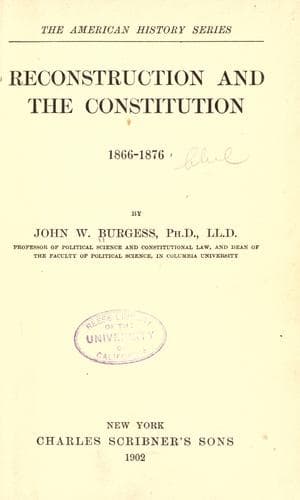
Reconstruction and the Constitution, 1866-1876Burgess, John William
History
Reconstruction and the Constitution, 1866-1876
Burgess, John William
Reconstruction (U.S. history, 1865-1877); United States -- Politics and government -- 1865-1877
Fourteenth Amendment, as Tennessee had done. When they refused to do
so, it was natural and it was necessary that Congress should at last
overturn all of the President's proceedings in Reconstruction, and all
of the proceedings made under his guidance, and begin _de novo_, and
upon the true constitutional principle of the exclusive power of
Congress to admit new "States" into the Union, or, more scientifically
expressed, to create new States or control their creation on territory
{111} of the Union in which loyal civil government did not exist.
[Sidenote: The correctness of the Republican view.]
There can be no question in the mind of any sound political scientist
and constitutional lawyer that Congress was in the right, logically,
morally, and legally, in insisting upon brushing aside the results of
executive Reconstruction in the winter of 1867, and beginning the work
itself from the bottom up. It ought to have done so in 1865. It ought
to have created, so soon as armed resistance to the execution of the
laws of the United States ceased, regular Territorial civil governments
throughout the country which had been in insurrection, and then have
admitted these Territories as "States" whenever the conditions
warranting the same should have been attained. The phantom of the
"indestructible State" had too strong an influence over the minds of
all at that moment to admit of such a solution of the question. But
after the experiences of 1865 and 1866, and the discussions in the last
session of the Thirty-ninth Congress, the minds of the Republicans at
least, both in and out of Congress, were prepared to break away from
the influence of this idea and to view the process of Reconstruction as
nothing but the admission of new "States" into the Union, new "States"
founded on territory and including inhabitants that had indeed once
formed "States," but had renounced Statehood in the Union through
disloyalty to the Union, and had been brought back to the position of
territories, civilly unorganized in local instance, but subject to the
exclusive jurisdiction of the central Government. From such a point of
view, the method of procedure was plain. While it is strange that the
Congress did not follow this course in 1865, it is simply astounding
that it made such a mess of it in 1867.
{112} [Sidenote: The Reconstruction bill.]
Public-domain text, read in full here on John Shaqi.
Reviews
Reviews
No reviews yet
Be the first to share your thoughts on this work.
Elsewhere in the archive
Join the Discussion
Join the discussion
Sign in to leave a comment or review.
Sign InorCreate an account