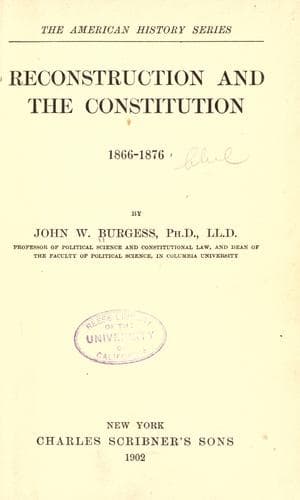
Reconstruction and the Constitution, 1866-1876Burgess, John William
History
Reconstruction and the Constitution, 1866-1876
Burgess, John William
Reconstruction (U.S. history, 1865-1877); United States -- Politics and government -- 1865-1877
There was hardly a line in the entire bill which would stand the test
of the Constitution. In the first place, the Congress of the United
States, or any other part of the Government of the United States, can
establish martial law in any part of the territory of the United States
only when and where there is armed resistance to the execution of the
laws of the United States, or of some "State" or Territory whose
jurisdiction is being defended by the Government of the United States.
Such was not the condition anywhere in the South. The Executive had
proclaimed that such resistance had ceased everywhere several months
before; that he had appointed civil officers throughout the South for
the execution of the laws of the United States, in many cases with the
advice and consent of the Senate; that these laws were in operation
everywhere; and that the United States courts were open everywhere and
in the unhindered discharge of their functions and duties. It was not
pretended, of course, that there was armed resistance to the execution
of the laws of the reconstructed "States," and that the military of the
United States was to act simply in support of "State" authority. There
were here and there, it is true, some of the remains of the military
authority of the United States, exercised during the period of the
insurrection, but they were a very poor basis upon which to found a
resumption of the reign of martial law throughout the length and
breadth of the South. No sane and just mind can consider for a moment
such a ground as sufficient in policy, morals or constitutional law.
While the people of these districts {114} which had attempted to secede
from the Union had forfeited their rights to the "State" form of local
government, they still had, after they had ceased from armed resistance
to the Government of the United States, the rights guaranteed to the
criminal by the Constitution of the United States--the right to be
presented by a grand jury and tried by a petit jury in the civil
tribunals of the United States, under the ordinary forms and guarantees
of the common law, even though the crime charged should be treason
itself.
[Sidenote: The bill in its attempt to rob the President of his office
of Commander-in-chief.]
In the second place, the bill undertook to rob the President of his
constitutional prerogative of commandership-in-chief over the army, and
vest the same in the General of the army. This was so evident that no
one could fail to see that it was a bill directed as much against the
powers of the President of the United States as against the late
Confederates of the South.
Public-domain text, read in full here on John Shaqi.
Reviews
Reviews
No reviews yet
Be the first to share your thoughts on this work.
Elsewhere in the archive
Join the Discussion
Join the discussion
Sign in to leave a comment or review.
Sign InorCreate an account