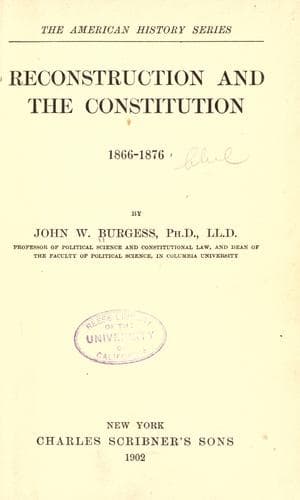
Reconstruction and the Constitution, 1866-1876Burgess, John William
History
Reconstruction and the Constitution, 1866-1876
Burgess, John William
Reconstruction (U.S. history, 1865-1877); United States -- Politics and government -- 1865-1877
And in the third place, the bill assumed to suspend the writ of Habeas
Corpus, substantially, while the Constitution forbids this to be done
by any part of the Government of the United States, except in time of
war or public danger. There was no war, and to say that there was
public danger of the character meant by the constitutional exception
was to exaggerate the condition of things entirely beyond all fact or
reason.
[Sidenote: The brutality of the measure.]
The bill was the most brutal proposition ever introduced into the
Congress of the United States by a responsible committee, and it would
never have been tolerated except at such a time of partisan excitement
and exaggerated suspicions. Even under such conditions Congress would
not pass it as introduced, but incorporated into it many modifying
provisions, most of which, however, while reflecting the honest
sentiments of the lawmakers, give little {115} evidence of good
political science or sound constitutional law.
[Sidenote: The opposition of conservative Republicans to the bill.]
[Sidenote: Mr. Blaine's proposed changes in the bill.]
The two points in the bill which the conservative Republicans were
unable to accept were, first, the establishment of martial law for an
indefinite period and without any provision tor a way of future escape
from its rigors; and, second, the usurpation of the President's
constitutional prerogative of commandership-in-chief of the army. It
soon became manifest that the bill could not pass without the
introduction of a clause covering the first point and without a change
of the provision in regard to the second. A number of the conservative
Republicans had indicated these things, when Mr. Blaine squarely asked
Mr. Stevens to incorporate an amendment in the bill which should
provide a way of escape from the martial rule which the bill proposed
to establish. Mr. Blaine's amendment held out the promise of the
admission of each of the ten communities now to be thrown into military
divisions to its proper position as a "State" of the Union when it
should adopt the proposed Fourteenth Amendment and conform its
constitution and laws thereto, should provide by its constitution for
universal male suffrage without regard to race, color or previous
condition of servitude, and should adopt a constitution with such a
provision in it by popular vote, and when Congress should approve of
the said constitution.
[Sidenote: Criticism of Mr. Blaine's propositions.]
Public-domain text, read in full here on John Shaqi.
Reviews
Reviews
No reviews yet
Be the first to share your thoughts on this work.
Elsewhere in the archive
Join the Discussion
Join the discussion
Sign in to leave a comment or review.
Sign InorCreate an account