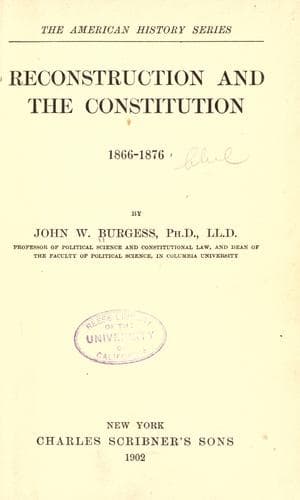
Reconstruction and the Constitution, 1866-1876Burgess, John William
History
Reconstruction and the Constitution, 1866-1876
Burgess, John William
Reconstruction (U.S. history, 1865-1877); United States -- Politics and government -- 1865-1877
This plan recognized, in the first place, the continued existence of
the "States" in rebellion as "States" of, and in, the Union. More
exactly, it regarded the rebellion against the United States within
these "States" as the act of combinations of disloyal persons, and not
as the act of the "States" at all. These combinations had subverted the
loyal governments within these "States," but the "States" themselves
were not disloyal, because they could not be. They were impersonal
entities, incapable of committing treason or any other wrong. According
to this view the work of Reconstruction consisted simply in placing the
loyal element in a "State" in possession of the government of the
"State."
In the second place, therefore, Mr. Lincoln's plan contained the
principle that the work of Reconstruction was an executive problem. It
was the work of the Executive, through the power of pardon, to create a
loyal class in a "State" which had been the scene of rebellion, and it
was the work of the Executive to support that class by the military
power in taking possession of, organizing, and operating, the "State"
government.
{10} [Sidenote: Mr. Lincoln's oath of allegiance, and the loyal class
to be created by the taking of this oath.]
And so, Mr. Lincoln undertook to create such a class by constructing an
oath of future loyalty and allegiance to the United States of the
following tenor: "I, ---- ----, do solemnly swear, in the presence of
Almighty God, that I will henceforth faithfully support, protect, and
defend the Constitution of the United States and the union of the
States thereunder; and that I will in like manner abide by and
faithfully support all acts of Congress passed during the existing
rebellion with reference to slaves, so long and so far as not repealed,
modified, or held void, by Congress or by decision of the Supreme
Court; and that I will in like manner abide by and faithfully support
all proclamations of the President during the existing rebellion having
reference to slaves, so long and so far as not modified by the Supreme
Court. So help me God;" and by ordaining that all persons who would
voluntarily take this oath, unless they had been civil or diplomatic
officers of the "so-called Confederate Government," or military
officers thereof above the rank of colonel in the army or lieutenant in
the navy, or had left seats in the United States Congress or judicial
office under the United States, or had resigned commissions in the army
or navy of the United States, in order to aid in the rebellion, or had
been engaged in treating colored persons found in the United States
service in any capacity, or white persons in charge of them, in any
other manner than as prisoners of war, would be regarded as having
re-established their loyalty and allegiance to the United States.
Public-domain text, read in full here on John Shaqi.
Reviews
Reviews
No reviews yet
Be the first to share your thoughts on this work.
Join the Discussion
Join the discussion
Sign in to leave a comment or review.
Sign InorCreate an account