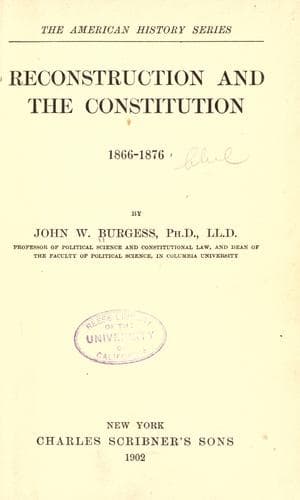
Reconstruction and the Constitution, 1866-1876Burgess, John William
History
Reconstruction and the Constitution, 1866-1876
Burgess, John William
Reconstruction (U.S. history, 1865-1877); United States -- Politics and government -- 1865-1877
Then came the provision which offered the terms of escape from this new
military régime. They were, first, the exercise of universal manhood
suffrage, that is the suffrage of all male citizens, twenty-one years
of age, without regard to race, color or previous condition of
servitude, who were not disfranchised for participation in rebellion or
for felony at common law, and who had resided for one year in the
so-called "rebel State," in the election of delegates to a
constitutional convention in the so-called "rebel State"; second, the
framing of a "State" constitution by a convention composed of delegates
so elected, and not disqualified by participation in rebellion or by
the commission of felony, which constitution should conform in all
respects to the Constitution of the United States and which should
contain, as a permanent principle, the same law of suffrage as that
prescribed by this Act for the election of the delegates to the
convention; third, the ratification of this constitution by a majority
of the voters, as designated by the law of suffrage for the choice of
delegates to the convention, voting upon the question of ratification;
fourth, the approval by Congress of this constitution; and fifth, and
last, the adoption of the proposed Fourteenth Amendment to the
Constitution of the United States by the legislature created by such
adopted and approved "State" constitution, and by a sufficient number
of the legislatures {121} of other "States" to make it a part of the
Constitution of the United States.
The measure contained, in the last place, a sort of saving clause in
regard to the existing civil governments which had been established in
all these communities under the direction of the President, and which
were now to be displaced. It had been already provided, in section
third, that the military commander of a district might use the existing
civil courts, if he saw fit to do so, so long as the reign of law and
order might be so preserved, and the final section provided that any
civil government which might exist in these districts should be
regarded as provisional, and should be in all respects subject to the
paramount authority of the United States, which should control, and
might abolish, modify, or supersede the same, and that the voters for
the election of the officers of such provisional governments should be
required to have only the qualifications prescribed in this Act for
voters for the delegates to the said "State" convention, and persons
elected to place and office in such provisional governments must not
have the disqualifications prescribed in the proposed Fourteenth
Amendment to the Constitution of the United States. It had evidently
occurred to the Republican leaders that they might have to make use of
some of the machinery of the existing civil governments established
under the direction of the President in these regions in executing
their own plan of Reconstruction.
Public-domain text, read in full here on John Shaqi.
Reviews
Reviews
No reviews yet
Be the first to share your thoughts on this work.
Elsewhere in the archive
Join the Discussion
Join the discussion
Sign in to leave a comment or review.
Sign InorCreate an account