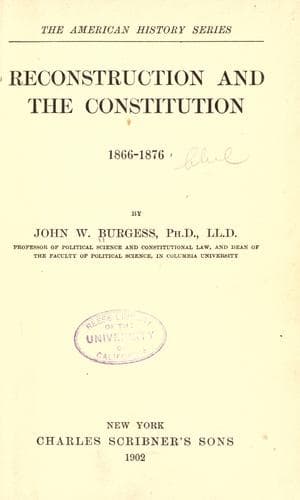
Reconstruction and the Constitution, 1866-1876Burgess, John William
History
Reconstruction and the Constitution, 1866-1876
Burgess, John William
Reconstruction (U.S. history, 1865-1877); United States -- Politics and government -- 1865-1877
It contained the following declarations and provisions. First, the
preamble designated the ten communities reconstructed under the
President's direction as "the rebel States of Virginia, North Carolina,
South Carolina, Georgia," and so on. This was certainly an untruth. If
they were "States" at all, they certainly were not rebel "States." They
might with some appearance of correctness and sincerity have been
termed the late rebel "States," but to be called simply rebel "States"
was, to say the very least, one of the {119} grossest exaggerations to
be found in the wording of the statutes of Congress. It was simply a
play on words whereby to justify a dubious procedure. It was at the
very best, a confounding of the supposed sentiments of the population
of these regions with actual political status. Second, the preamble
declared that no legal "State" governments or adequate protection for
life or property existed in these "rebel States." As a legal
proposition the first part of this declaration was true, and as a
matter of fact the second part was substantially true. It would have
been an unprecedented thing if anything like an adequate protection of
life and property had been re-established, in the short period of two
years, in communities which had been disturbed, demoralized and
destroyed by four years of civil war, especially when the outcome of
the conflict was total defeat and the utter destruction of the basis of
the old social, political, and economic systems. It was, however, a
serious question whether such a situation required drastic measures
rather than mild and soothing measures.
The Republican Congress decided, after much deliberation, that the
former were necessary to the maintenance of peace and good order, and,
therefore, enacted that the "said rebel States" should be divided into
five military districts, as previously described in the original bill;
that the President should assign to the command of each of these an
army officer of not lower rank than brigadier-general, and place under
his command a sufficient force to enable him to perform his duties and
execute his authority in his district; that these commanders should
have the power to govern these districts by martial law in so far as,
in their judgment, the reign of order and the preservation of the
public peace might demand, under the limitations simply that "all
persons put under military arrest {120} by virtue of this act shall be
tried without unnecessary delay, and no cruel or unusual punishment
shall be inflicted, and no sentence of any military commission or
tribunal hereby authorized affecting the life or liberty of any person,
shall be executed until it is approved by the officer in command of the
district--and no sentence of death under the provisions of this act
shall be carried into effect without the approval of the President."
Public-domain text, read in full here on John Shaqi.
Reviews
Reviews
No reviews yet
Be the first to share your thoughts on this work.
Elsewhere in the archive
Join the Discussion
Join the discussion
Sign in to leave a comment or review.
Sign InorCreate an account