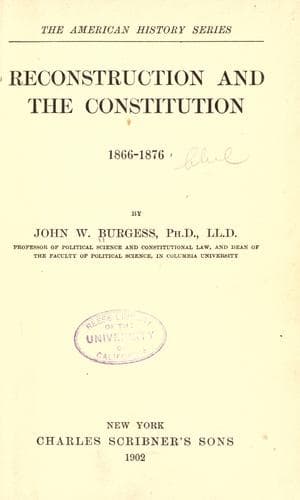
Reconstruction and the Constitution, 1866-1876Burgess, John William
History
Reconstruction and the Constitution, 1866-1876
Burgess, John William
Reconstruction (U.S. history, 1865-1877); United States -- Politics and government -- 1865-1877
{123} The propositions contained in the Tenure-of-Office bill were,
however, of a very different significance. There was no clause in the
Constitution which by express literal grant vested the power to dismiss
from office in the President, but the clause which made the President
solely responsible for the execution of the laws was interpreted by the
first Congress as doing so. Madison took the ground that the President
must have this power in order to secure the necessary obedience in his
subordinates, and declared that the convention which framed the
Constitution so understood it and so intended it. This is certainly
sound political science and correct constitutional interpretation. It
had also been the practice of the Government from the beginning. The
Whigs had undertaken to reverse it in their contest with Jackson, and
Webster had given his opinion that good political science required that
dismissal from office should be treated as an incident of appointment,
and should be effected in the same manner as appointment, i.e., with
the concurrence of the Senate, and that the decision of 1789 on this
subject was, in his opinion, erroneous from the point of view of a
proper interpretation of the Constitution as well. But the Whigs did
not succeed, as we have seen, in their attempt to break down
Presidential prerogative and introduce parliamentary government, and
the practice of the Government on this subject remained, after, as
before, the fourth decade of the century, the same.
[Sidenote: The reasons for the Tenure-of-Office bill.]
During the experiences of the years 1865 and 1866 the Republicans
feared that the President would use this great power of dismissal from
office in order to make the entire official system solid with himself
on the subject of Reconstruction, and toward the end of 1866 they
suspected and asserted that he was dismissing officers {124} from their
positions simply on the ground of a difference of opinion with himself
on this subject, and they professed to believe that he would make a
clean sweep of all such as soon as Congress should adjourn. There is
little doubt that excessive partisan feeling made them exaggerate
greatly what the President had done and what he intended to do. The
President was guided by Mr. Seward in all public matters except his
imprudent speeches, and Seward's conservative and diplomatic
disposition and methods were all against any such radical and reckless
procedure. Besides, it was the constitutional right of the President to
require obedience in their official acts from his subordinates, and to
dismiss them when in his opinion their views of policy interfered with
the discharge of their official duties as he required them to be
discharged. The Thirty-ninth Congress, however, resolved to disregard
the precedents set by all of its predecessors and to dispute the
President's prerogative of control over the tenure of his subordinates.
[Sidenote: The contents of the bill.]
Public-domain text, read in full here on John Shaqi.
Reviews
Reviews
No reviews yet
Be the first to share your thoughts on this work.
Elsewhere in the archive
Join the Discussion
Join the discussion
Sign in to leave a comment or review.
Sign InorCreate an account