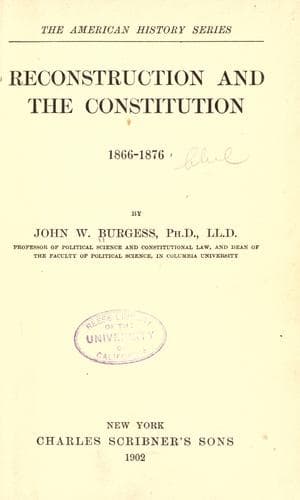
Reconstruction and the Constitution, 1866-1876Burgess, John William
History
Reconstruction and the Constitution, 1866-1876
Burgess, John William
Reconstruction (U.S. history, 1865-1877); United States -- Politics and government -- 1865-1877
The bill drafted for this purpose made the removal of all officers,
appointed by and with the consent of the Senate, except only members of
the President's Cabinet, subject to the consent of the Senate. This
consent might be given in the form of a ratification of the nomination
of a successor to any officer. It allowed the President, during a
recess of the Senate, the power of suspension for misconduct in office,
crime, legal disqualification or incapacity, and of making appointment
of a suitable person to discharge temporarily the duties of such
suspended officer, but it required of the President a report of all
such suspensions to the Senate within the first twenty days of the next
meeting of the Senate, with the reasons therefor, and reinstated the
suspended officer in case the Senate {125} should not concur in the
suspension. If the Senate should concur, the President must remove the
officer, and appoint, with the advice and consent of the Senate,
another person in his place.
[Sidenote: Discussion of the bill.]
From the point of view of the present this would seem, in all
conscience, to have been a sufficient usurpation of the President's
constitutional powers to have satisfied the most radical and reckless
interpretation of the organic law. But the bill had hardly come under
discussion when Senator Howe moved to strike out the clause excepting
the Cabinet officers from its operation, and although the Senate
refused to pass this amendment, the House of Representatives did so
when the bill came before it. The Senate, however, refused to concur on
the ground, of course, that the intimate and confidential relations
which should exist between the President and the members of his Cabinet
made it necessary that the President should have only the men of his
own choice in these positions. The strenuous insistence of the House,
however, forced the Senate to a compromise upon the subject, and the
bill was finally made to provide that the members of the Cabinet should
"hold their offices, respectively, for and during the term of the
President by whom they have been appointed, and for one month
thereafter, subject to removal by and with the consent of the Senate."
That is, that a Cabinet officer might hold his position against the
will of the President who appointed him during the entire term of the
President and for one month of the term of his successor unless the
Senate should agree to such officer's removal either directly or by
ratification of the nomination of a successor.
[Sidenote: The provisions for enforcing the measure.]
Public-domain text, read in full here on John Shaqi.
Reviews
Reviews
No reviews yet
Be the first to share your thoughts on this work.
Elsewhere in the archive
Join the Discussion
Join the discussion
Sign in to leave a comment or review.
Sign InorCreate an account