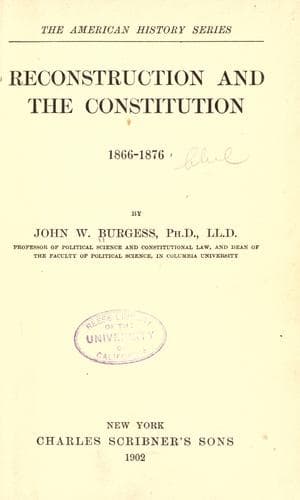
Reconstruction and the Constitution, 1866-1876Burgess, John William
History
Reconstruction and the Constitution, 1866-1876
Burgess, John William
Reconstruction (U.S. history, 1865-1877); United States -- Politics and government -- 1865-1877
Undoubtedly, in some of the baser minds among them, the determination
to create Republican party "States" in the South was a very weighty
consideration, but just as undoubtedly the consideration with the
majority of them was the conviction that the work of the four years of
war might have to be done all over again unless a new political people,
a new body of suffrage holders, should be created at the South, whose
members had never been disloyal. But even from this point of view
again, it is difficult to understand how they could have failed to see
that the Constitution required that this should be done through the
forms of Territorial civil government, instead of through the forms of
martial law. Put the best light upon their conduct that is possible,
there is still left the conviction that the fanaticism of extreme
partisanship had an undue influence over them all. {128} The contest
with the President had blinded their perceptions as to the morality,
legality and propriety of the means they were willing to employ in
securing the victory over him.
[Sidenote: Congressional encroachment on the President's military
prerogatives.]
As this contest developed it dwarfed, to say the least, all other
considerations. Even as late as when the Reconstruction bill was
passed, the majority of the Republicans refused to vote to take the
President's military prerogatives from him. In less than a fortnight
from this time, however, they voted, in a section of the Army
Appropriation bill, "that the head-quarters of the General of the army
of the United States shall be at the city of Washington, and all orders
and instructions relating to military operations issued by the
President or Secretary of War shall be issued through the General of
the army, and, in case of his inability, through the next in rank. The
General of the army shall not be removed, suspended, or relieved from
command, or assigned to duty elsewhere than at said head-quarters,
except at his own request, without the previous approval of the Senate;
and any orders or instructions relating to military operations issued
contrary to the requirements of this section shall be null and void;
and any officer who shall issue orders or instructions contrary to the
provisions of this section shall be deemed guilty of a misdemeanor in
office; and any officer of the army who shall transmit, convey, or obey
any orders or instructions so issued contrary to the provisions of this
section, knowing that such orders were so issued, shall be liable to
imprisonment for not less than two nor more than twenty years, upon
conviction in any court of competent jurisdiction."
Public-domain text, read in full here on John Shaqi.
Reviews
Reviews
No reviews yet
Be the first to share your thoughts on this work.
Elsewhere in the archive
Join the Discussion
Join the discussion
Sign in to leave a comment or review.
Sign InorCreate an account