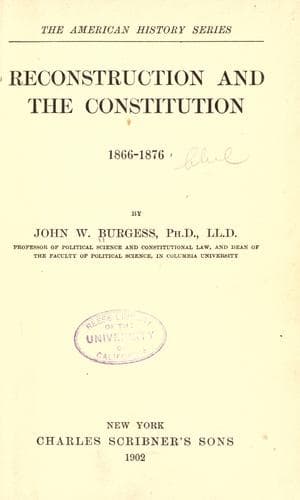
Reconstruction and the Constitution, 1866-1876Burgess, John William
History
Reconstruction and the Constitution, 1866-1876
Burgess, John William
Reconstruction (U.S. history, 1865-1877); United States -- Politics and government -- 1865-1877
To the mind of any unprejudiced constitutional lawyer, at the present
day, this act must appear as a gross {129} usurpation by Congress of
the President's military powers conferred upon him by the Constitution.
The Constitution makes the President the Commander-in-Chief of the army
and navy, and gives Congress no power whatsoever over the methods or
channels by, and through, which he may issue his military commands.
Neither does the Constitution give Congress any power to assign any of
the officers or troops of the army to any particular position. These
are all functions of the commandership-in-chief, and, unless expressly
granted by the Constitution to some other department of the Government,
belong to the President.
It was not only a usurpation by Congress to pass such an act, but it
was a mean thing to do it as a section of an appropriation bill; and
there is no escaping the suspicion that it had a sinister purpose,
namely, to entrap the President in the commission of what Congress had
made a high misdemeanor, and open the way for his impeachment and
expulsion from office. The President signed this bill, however, in
order to save the appropriations for the support of the army, although
he protested strongly against the seizure of his constitutional powers
by the Congress.
[Sidenote: The supplementary Reconstruction bill.]
On the same day that the vetoes of the Reconstruction bill and the
Tenure-of-Office bill were sent to Congress, this body passed a bill
supplementary to the first measure. It was in the nature of an
administrative measure for the purpose of carrying out the new plan of
Reconstruction. It ordered the commanding generals of the respective
districts to cause a registration to be made before September 1st next
following of all male citizens of the United States, twenty-one years
of age and over, resident in each county or parish in the "State" or
"States" included in their respective districts, who were qualified as
{130} prescribed by the Reconstruction Act to vote for delegates to a
constitutional convention, and who had taken an oath asserting
citizenship and residence, and freedom from disfranchisement on account
of participation in rebellion or the commission of felony, and had
sworn that they had never engaged in insurrection or rebellion against
the United States, or given aid and comfort to the enemies of the
United States after having been members of Congress or of a "State"
legislature, or officers of the United States or of a "State" of the
Union, and that they would henceforth faithfully support the
Constitution and obey the laws of the United States and encourage
others to do so.
Public-domain text, read in full here on John Shaqi.
Reviews
Reviews
No reviews yet
Be the first to share your thoughts on this work.
Elsewhere in the archive
Join the Discussion
Join the discussion
Sign in to leave a comment or review.
Sign InorCreate an account