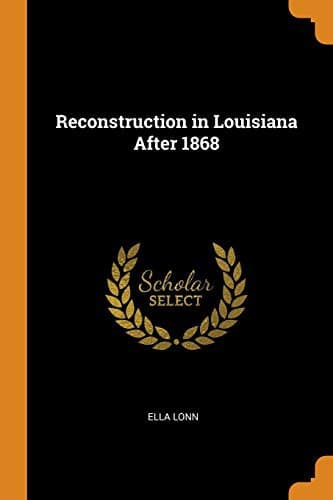
Reconstruction in Louisiana after 1868 — John Shaqi
Reconstruction in Louisiana after 1868Lonn, Ella
History
Reconstruction in Louisiana after 1868
Lonn, Ella
Louisiana -- Politics and government -- 1865-1950; Reconstruction (U.S. history, 1865-1877) -- Louisiana; Thesis (Ph. D.)
A Carpet-bag Legislature in Session
The general character of the work done in the Louisiana Assembly
during the sessions of 1869 and 1870 was distinctly inferior; the
tone of the debate low; and the conduct paralleled only in the worst
of the reconstruction legislatures. The ignorance of the members does
not appear glaringly in the records of 1869, for the more illiterate
did not engage in the debate, certainly did not venture upon lengthy
addresses. It is only occasionally that we are appalled by the dense
ignorance revealed, as when the colored legislator Burrel broke out
into a mass of incoherent repetitions in defense of the St. Charles
pavement bill.[60]
The debate was distinctly partisan. The following outburst, provoked by
the debate on the militia bill, is sufficiently suggestive:
Is it possible that men in broad daylight will say that we should
not call on the Republican party to give security to the people?
That we receive this amendment that men should be organized into
a militia, that will call every disturbance of the peace a “nigger
insurrection”? Men should prove that they are loyal before they
can be trusted to go into the militia. This amendment ought to be
dammed by this House. What, this democracy to be organized into a
militia to execute Andrew Johnson’s policy! This amendment is full of
deviltry.[61]
On another occasion even the speaker stated as a good reason why a
certain bill should pass that the board to be affected by it were all
good Republicans. The bill promptly passed.[62] January 19 a cool
resolution was offered that the persons voted for in the parishes
where a fair election had been held, the twenty-six parishes where
the Democrats had had a majority being calmly ignored, should meet to
vote for President and Vice-President.[63] It is significant, however,
that sharply drawn as was the party line, the sectional feeling
manifested was distinctly pro-Southern. When a measure was offered
for a contribution to a Lincoln Monument, few spoke for it, while
most felt it frankly impossible that the South could be expected to
contribute.[64] On the other hand, when the appeal to help bury the
Confederate dead at Fredericksburg came up the following session, even
such a hot-headed Unionist as Mr. McMillan spoke reverently in advocacy
of the appropriation.[65]
Public-domain text, read in full here on John Shaqi.
Reviews
Reviews
No reviews yet
Be the first to share your thoughts on this work.
Join the Discussion
Join the discussion
Sign in to leave a comment or review.
Sign InorCreate an account