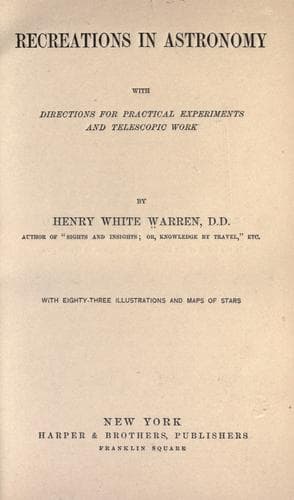
Recreations in Astronomy: With Directions for Practical Experiments and Telescopic WorkWarren, Henry White
Religion
Recreations in Astronomy: With Directions for Practical Experiments and Telescopic Work
Warren, Henry White
Astronomy
For example, the total attractive effect of one planet on the other
for 450 years is to quicken its speed. The effect for the next 450
years is to retard. The place of Saturn, when all the retardations
have accumulated for 450 years, is one degree behind what it is
computed if they are not considered; and 450 years later it will
be one degree before its computed place--a perturbation of two
degrees. When a bullet is a little heavier or ragged on one side,
it will constantly swerve in that direction. The spiral groove in
the rifle, of one turn in forty-five feet, turns the disturbing
weight or raggedness from side to side--makes one error correct
another, and so the ball flies straight to the bull's-eye. So the
place of Jupiter and Saturn, though further complicated by four
moons in the case of Jupiter, and eight in the case of Saturn, and
also by perturbations caused by other planets, can be calculated
with exceeding nicety.
The difficulties would be greatly increased if the orbits [Page 13]
of Saturn and Jupiter, instead of being 400,000,000 miles apart,
were interlaced. Yet there are the orbits of one hundred and
ninety-two asteroids so interlaced that, if they were made of wire,
no one could be lifted without raising the whole net-work of them.
Nevertheless, all these swift chariots of the sky race along the
course of their intermingling tracks as securely as if they were
each guided by an intelligent mind. _They are guided by an
intelligent mind and an almighty arm._
Still more complicated is the question of the mutual attractions of
all the planets. Lagrange has been able to show, by a mathematical
genius that seems little short of omniscience in his single department
of knowledge, that there is a discovered system of oscillations,
affecting the entire planetary system, the periods of which are
immensely long. The number of these oscillations is equal to that
of all the planets, and their periods range from 50,000 to 2,000,000
years,
Looking into the open page of the starry heavens we see double
stars, the constituent parts of which must revolve around a centre
common to them both, or rush to a common ruin. Eagerly we look
to see if they revolve, and beholding them in the very act, we
conclude, not groundlessly, that the same great law of gravitation
holds good in distant stellar spaces, and that there the same sufficient
mind plans, and the same sufficient power directs and controls all
movements in harmony and security.
Public-domain text, read in full here on John Shaqi.
Reviews
Reviews
No reviews yet
Be the first to share your thoughts on this work.
Join the Discussion
Join the discussion
Sign in to leave a comment or review.
Sign InorCreate an account