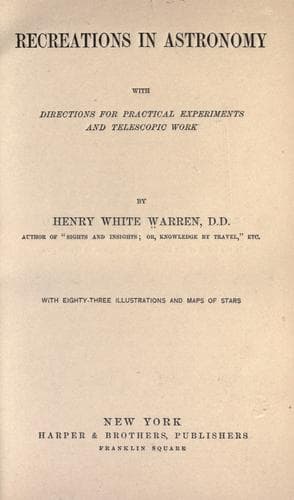
Recreations in Astronomy: With Directions for Practical Experiments and Telescopic WorkWarren, Henry White
Religion
Recreations in Astronomy: With Directions for Practical Experiments and Telescopic Work
Warren, Henry White
Astronomy
On the 1st day of September, 1859, two astronomers, independently
of each other, saw a sudden brightening on the surface of the sun.
Probably two large meteoric masses were travelling side by side
at two or three hundred miles per second, and striking the sun's
atmosphere, suddenly blazed into light bright enough to be seen
on the intolerable light of the photosphere as a background. The
earth responded to this new cause of brilliance and heat in the
sun. Vivid auroras appeared, not only at the north and south poles,
but even where such spectacles are seldom seen. The electro-magnetic
[Page 20] disturbances were more distinctly marked. "In many places
the telegraphic wires struck work. In Washington and Philadelphia
the electric signalmen received severe electric shocks; at a station
in Norway the telegraphic apparatus was set fire to; and at Boston a
flame of fire followed the pen of Bain's electric telegraph." There
is the best of reason for believing that a continuous succession of
such bodies might have gone far toward rendering the earth
uncomfortable as a place of residence.
Of course, the same result of heat and light would follow from
compression, if a body had the power of contraction in itself. We
endowed every particle of our gas, myriads of miles in extent, with an
attraction for every other particle. It immediately compressed itself
into a light-giving body, which flamed out through the interstellar
spaces, flushing all the celestial regions with exuberant light.
But heat exerts a repellent force among particles, and soon an
equilibrium is reached, for there comes a time when the contracting
body can contract no farther. But heat and light radiate away into
cold space, then contraction goes on evolving more light, and so
the suns flame on through the millions of years unquenched. It is
estimated that the contraction of our sun, from filling immensity
of space to its present size, could not afford heat enough to last
more than 18,000,000 years, and that its contraction from its present
density (that of a swamp) to such rock as that of which our earth
is composed, could supply heat enough for 17,000,000 years longer.
But the far-seeing mind of man knows a time must come when the
present force of attraction [Page 21] shall have produced all the
heat it can, and a new force of attraction must be added, or the sun
itself will become cold as a cinder, dead as a burned-out char.
Public-domain text, read in full here on John Shaqi.
Reviews
Reviews
No reviews yet
Be the first to share your thoughts on this work.
Join the Discussion
Join the discussion
Sign in to leave a comment or review.
Sign InorCreate an account