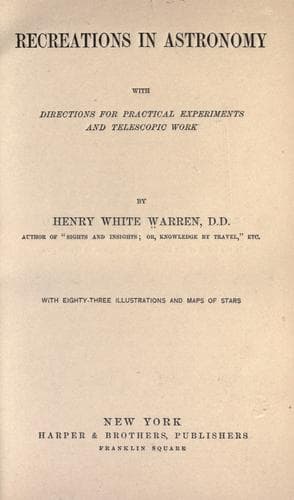
Recreations in Astronomy: With Directions for Practical Experiments and Telescopic WorkWarren, Henry White
Religion
Recreations in Astronomy: With Directions for Practical Experiments and Telescopic Work
Warren, Henry White
Astronomy
Every little pansy, tender as fancy, pearled with evanescent dew,
fresh as a new creation of sunbeams, has power to suppress in one
part of its petals all vibrations we call red, in another those
we call yellow, and purple, and reflect each of these in other
parts of the same tender petal. "Pansies are for thoughts," even
more thoughts than poor Ophelia knew. An evening cloud that is
dense enough to absorb all the faster and weaker vibrations, leaving
only the stronger to come through, will be said to be red; because
the vibrations that produce the impression we have so named are
the only ones that have vigor enough to get through. It is like an
army charging upon a fortress. Under the deadly fire and fearful
obstructions six-sevenths go down, but one-seventh comes through
with the glory of victory upon its face.
Light comes in undulations to the eye, as tones of sound to the
ear. Must not light also sing? The lowest tone we can hear is made
by 16.5 vibrations of air per second; the highest, so shrill and
"fine that nothing lives 'twixt it and silence," is made by 38,000
vibrations per second. Between these extremes lie eleven octaves;
C of the G clef having 258-7/8 vibrations to the second, and its
octave above 517-1/2. Not that sound vibrations cease [Page 27] at
38,000, but our organs are not fitted to hear beyond those
limitations. If our ears were delicate enough, we could hear even up
to the almost infinite vibrations of light. In one of those
semi-inspirations we find in Shakspeare's works, he says--
"There's not the smallest orb which thou beholdest,
But in his motion like an angel sings,
Still quiring to the young-eyed cherubim.
Such harmony is in immortal souls;
But, whilst this muddy vesture of decay
Doth grossly close it in, we cannot hear it."
And that older poetry which is always highest truth says, "The
morning stars sing together." We misconstrued another passage which
we could not understand, and did not dare translate as it was written,
till science crept up to a perception of the truth that had been
standing there for ages, waiting a mind that could take it in.
Now we read as it is written--"Thou makest the out-goings of the
morning and evening to sing." Were our senses fine enough, we could
hear the separate keynote of every individual star. Stars differ
in glory and in power, and so in the volume and pitch of their
song. Were our hearing sensitive enough, we could hear not only
the separate key-notes but the infinite swelling harmony of these
myriad stars of the sky, as they pour their mighty tide of united
anthems in the ear of God:
"In reason's ear they all rejoice,
And utter forth a glorious voice.
Forever singing, as they shine,
The hand that made us is divine."
Public-domain text, read in full here on John Shaqi.
Reviews
Reviews
No reviews yet
Be the first to share your thoughts on this work.
Join the Discussion
Join the discussion
Sign in to leave a comment or review.
Sign InorCreate an account