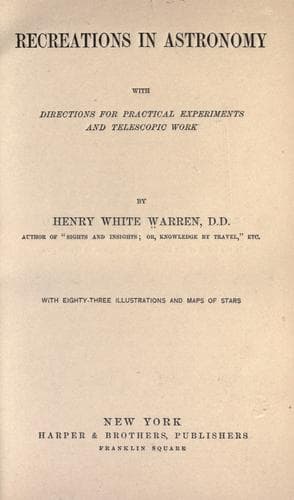
Recreations in Astronomy: With Directions for Practical Experiments and Telescopic WorkWarren, Henry White
Religion
Recreations in Astronomy: With Directions for Practical Experiments and Telescopic Work
Warren, Henry White
Astronomy
The nebular hypothesis is briefly this: All the matter composing
all the bodies of the sun, planets, and satellites once existed
in an exceedingly diffused state; [Page 183] rarer than any gas with
which we are acquainted, filling a space larger than the orbit of
Neptune. Gravitation gradually contracted this matter into a
condensing globe of immense extent. Some parts would naturally be
denser than others, and in the course of contraction a rotary
motion, it is affirmed, would be engendered. Rotation would flatten
the globe somewhat in the line of its axis. Contracting still more,
the rarer gases, aided by centrifugal force, would be left behind as
a ring that would ultimately be separated, like Saturn's ring, from
the retreating body. There would naturally be some places in this
ring denser than others; these would gradually absorb all the ring
into a planet, and still revolve about the central mass, and still
rotate on its own axis, throwing off rings from itself. Thus the
planet Neptune would be left behind in the first sun-ring, to make
its one moon; the planet Uranus left in the next sun-ring, to make
its four moons from four successive planet-rings; Saturn, with its
eight moons and three rings not made into moons, is left in the
third sun-ring; and so on down to Vulcan.
The outer planets would cool off first, become inhabitable, and,
as the sun contracted and they radiated their own heat, become
refrigerated and left behind by the retreating sun. Of course the
outer planets would move slowly; but as that portion of the sun
which gave them their motion drew in toward the centre, keeping
its absolute speed, and revolving in the lessening circles of a
contracting body, it would give the faster motion necessary to
be imparted to Earth, Mercury, and Vulcan.
The four great classes of facts confirmatory of this hypothesis
are as follows: 1st. All the planets move [Page 184] in the same
direction, and nearly in the same plane, as if thrown off from one
equator; 2d. The motions of the satellites about their primaries are
mostly in the same direction as that of their primaries about the
sun; 3d. The rotation of most of these bodies on their axes, and
also of the sun, is in the same direction as the motion of the
planets about the sun; 4th. The orbits of the planets, excluding
asteroids, and their satellites, have but a comparatively small
eccentricity; 5th. Certain nebulæ are observable in the heavens
which are not yet condensed into solids, but are still bright gas.
Public-domain text, read in full here on John Shaqi.
Reviews
Reviews
No reviews yet
Be the first to share your thoughts on this work.
Elsewhere in the archive
Join the Discussion
Join the discussion
Sign in to leave a comment or review.
Sign InorCreate an account