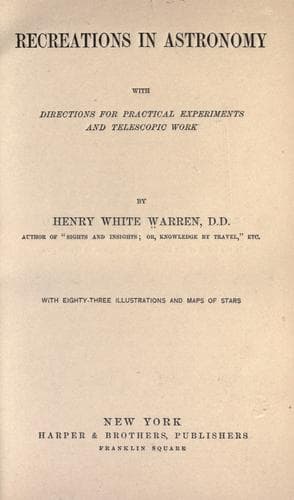
Recreations in Astronomy: With Directions for Practical Experiments and Telescopic WorkWarren, Henry White
Religion
Recreations in Astronomy: With Directions for Practical Experiments and Telescopic Work
Warren, Henry White
Astronomy
The materialistic evolutionist takes up the idea of a universe of
material world-stuff without form, and void, but so endowed as to
develop itself into orderly worlds, and adds to it this exceeding
advance, that when soil, sun, and chemical laws found themselves
properly related, a force in matter, latent for a million eons in
the original cloud, comes forward, and dead matter becomes alive
in the lowest order of vegetable life; there takes place, as Herbert
Spencer says, "a change from an indefinite, incoherent homogeneity,
into a definite, coherent heterogeneity, through continuous
differentiation and integration." The dead becomes alive; matter
passes from unconsciousness to consciousness; passes up from plant
to animal, from animal to man; takes on power to think, reason,
love, and adore. The theistic evolutionist may think that the same
process is gone through, but that an ever-present and working God
superintends, guides, and occasionally bestows a new endowment
of power that successively gives life, consciousness, mental,
affectional, and spiritual capacity.
Is this world-theory true? and if so, is either of the [Page 185]
evolution theories true also? If the first evolution theory is true,
the evolved man will hardly know which to adore most, the Being that
could so endow matter, or the matter capable of such endowment.
There are some difficulties in the way of the acceptance of the
nebular hypothesis that compel many of the most thorough scientists
of the day to withhold their assent to its entirety. The latest, and
one of the most competent writers on the subject, Professor Newcomb,
who is a mathematical astronomer, and not an easy theorist, evolving
the system of the universe from the depth of his own consciousness,
says: "Should any one be sceptical as to the sufficiency of these
laws to account for the present state of things, science can furnish
no evidence strong enough to overthrow his doubts until the sun
shall be found to be growing smaller by actual measurement, or the
nebulæ be actually seen to condense into stars and systems." In
one of the most elaborate defences of the theory, it is argued that
the hypothesis explains why only one of the four planets nearest
the sun can have a moon, and why there can be no planet inside of
Mercury. The discovery of the two satellites to Mars and of the
planet Vulcan makes it all the worse for these facts.
Some of the objections to the theory should be known by every thinker.
Laplace must have the cloud "diffused in consequence of excessive
heat," etc. Helmholtz, in order to account for the heat of the
contracting sun, must have the cloud relatively cold. How he and
his followers diffused the cloud without heat is not stated.
Public-domain text, read in full here on John Shaqi.
Reviews
Reviews
No reviews yet
Be the first to share your thoughts on this work.
Elsewhere in the archive
Join the Discussion
Join the discussion
Sign in to leave a comment or review.
Sign InorCreate an account