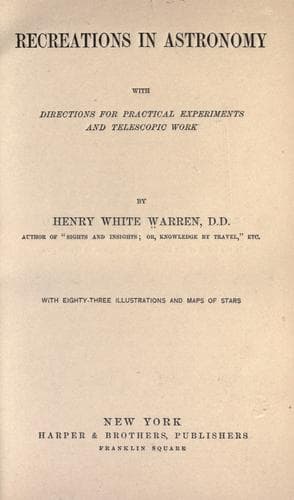
Recreations in Astronomy: With Directions for Practical Experiments and Telescopic WorkWarren, Henry White
Religion
Recreations in Astronomy: With Directions for Practical Experiments and Telescopic Work
Warren, Henry White
Astronomy
In regard to one Martial moon, Professor Kirkwood, on whom Proctor
conferred the highest title that could be conferred, "the modern
Kepler," says: "Unless some explanation can be given, the short period
of the inner satellite will be doubtless regarded as a conclusive
argument against the nebular hypothesis." If gravitation be sufficient
to account for the various motions of the heavenly bodies, we have
a perplexing problem in the star known as 1830 Groombridge, now
in the Hunting Dogs of Bootes. It is thought to have a speed of
two hundred miles per second--a velocity that all the known matter
in the universe could not give to the star by all its combined
attraction. Neither could all that attraction stop the motion of
the star, or bend it into an orbit. Its motion must be accounted
for on some hypothesis other than the nebular.
The nebulæ which we are able to observe are not altogether confirmatory
of the hypothesis under consideration. They have the most fantastic
shapes, as if they had no relation to rotating suns in the formative
stages. There are vast gaps in the middle, where they ought to be
densest. Mr. Plumer, in the _Natural Science Review_, [Page 188]
says, in regard to the results of the spectroscopic revelations: "We
are furnished with distinct proof that the gases so examined are not
only of nearly equal density, but that they exist in a low state of
_tension. This fact is fatal to the nebular theory._"
In the autumn of 1876 a star blazed out in Cygnus, which promised
to throw a flood of light on the question of world-making. Its
spectrum was like some of the fixed stars. It probably blazed ont
by condensation from some previously invisible nebula. But its
brilliancy diminished swiftly, when it ought to have taken millions
of years to cool. If the theory was true, it ought to have behaved
very differently. It should have regularly condensed from gas to a
solid sun by slow process. But, worst of all, after being a star
awhile, it showed unmistakable proofs of turning into a cloud-mist--a
star into a nebula, instead of _vice versa_. A possible explanation
will be considered under variable stars.
Such are a few of the many difficulties in the way of accepting
the nebular hypothesis, as at present explained, as being the true
mode of development of the solar system. Doubtless it has come
from a hot and diffused condition into its present state; but when
such men as Proctor, Newcomb, and Kirkwood see difficulties that
cannot be explained, contradictions that cannot be reconciled by
the principles of this theory, surely lesser men are obliged to
suspend judgment, and render the Scotch verdict of "not proven."
Whatever truth there may be in the theory will survive, and be
incorporated into the final solution of the problem; which solution
will be a much grander generalization of the human mind than the
nebular hypothesis.
Public-domain text, read in full here on John Shaqi.
Reviews
Reviews
No reviews yet
Be the first to share your thoughts on this work.
Elsewhere in the archive
Join the Discussion
Join the discussion
Sign in to leave a comment or review.
Sign InorCreate an account